F5 Application Delivery Controller Solutions Source | Edit on
Lab 6: Validating, Testing & Troubleshooting HA Group Functionality
Now that we have succesfully configured HA Groups we will perform a series of validation tests, as well as provide tips for troubleshooting.
Lab Tasks:
Task 1: Disable an interface to force HA Group actions
Task 2: Re-enable Interface, and Observe BIG-IP Behavior
Task 1: Disable an interface to force HA Group actions
In this task we will:
Manipulate an interface on the active BIG-IP
Disable an interface and observe BIG-IP behavior during failover
Monitor logs to review the failover process
On the active BIG-IP:
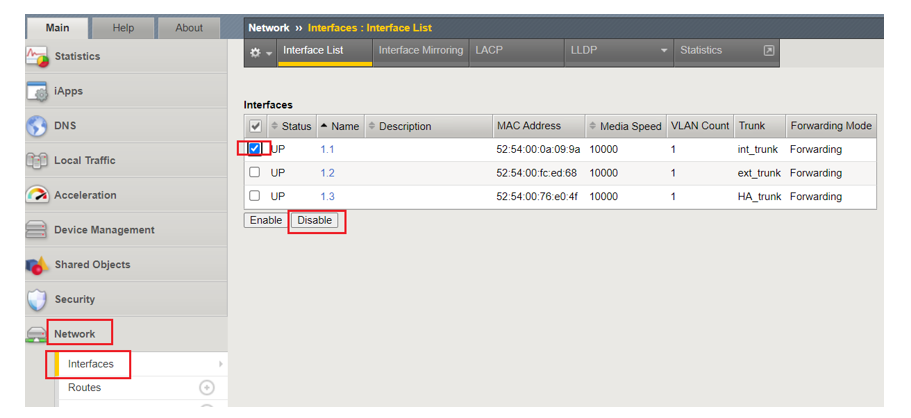
Navigate to Network, Interfaces, and place checkmark next to interface 1.1 then click on the Disable button.
During this time observe the BIG-IP status in the upper-left corner of each BIG-IP. Did a failover event occur and did state change?
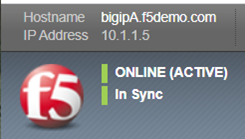
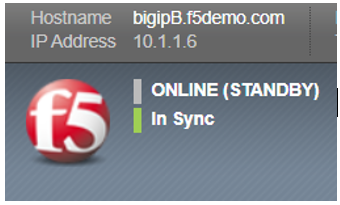
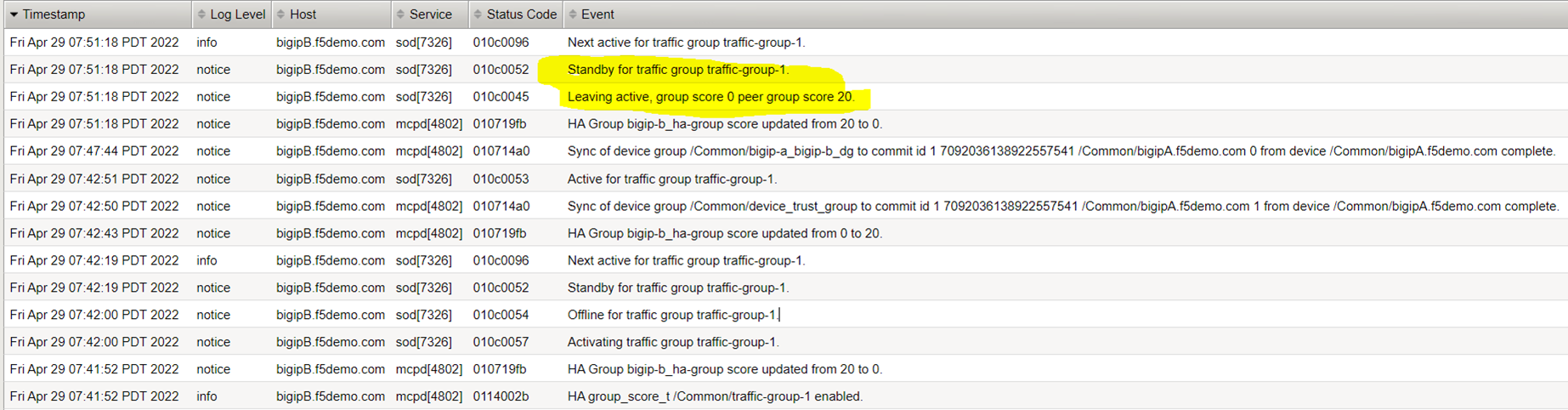
- Observe the log messages from each BIG-IP. Previously, BIG-IP A was the Standby device. Conversely, BIG-IP B was previously the Active
device.

Task 2: Re-enable Interface, and Observe BIG-IP Behavior
In Task 2, we will now re-enable Interface 1.1 on the Standby BIG-IP by performing the following step.
On the standby BIG-IP, Navigate to: Network > Interfaces > Interface List, and place checkmark next to interface 1.1 then click the Enable button.
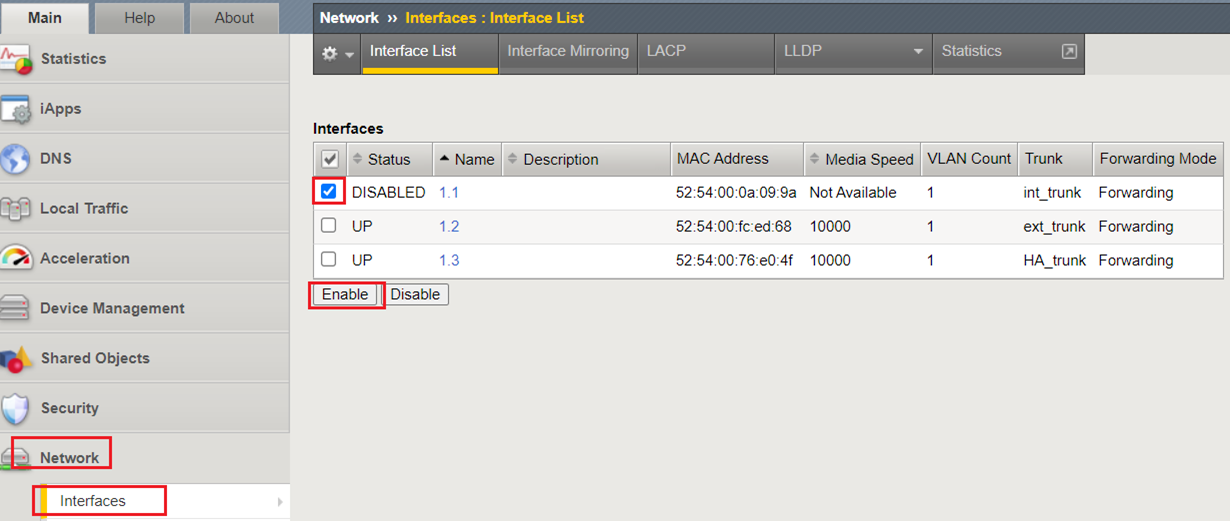
Did a failover event occur? If so, why or why not?
Lab Summary
In this lab, you tested & validated bringing down a BIG-IP interface, simulating a "link failure," and how that affects a failover event with HA Groups. After completion of these lab tasks, you should have a better understanding of how the BIG-IP behaves with an advanced HA Group Configuration.
This completes Lab 6.
Manual Chapter : Creating an Active-Standby Configuration using the Configuration Utility
K13946: Troubleshooting ConfigSync and device service clustering issues
- NOTE:
Ports Device group members should be able to communicate over ports 443, 4353, 1026 (UDP), and 22 (recommended). BIG-IP ASM requires the following additional Policy Sync TCP ports: 6123-6128
Task 1: Create BIG-IP Trunks
tmsh create net trunk int_trunk interfaces add { 1.1 }
tmsh create net trunk ext_trunk interfaces add { 1.2 }
tmsh create net trunk HA_trunk interfaces add { 1.3 }
Task 2: Create BIG-IP VLANs
tmsh create net vlan int_vlan_10 tag 10 interfaces add { int_trunk }
tmsh create net vlan ext_vlan_20 tag 20 interfaces add { ext_trunk }
tmsh create net vlan HA_vlan_30 tag 30 interfaces add { HA_trunk }
Task 3: Create BIG-IP Self IPs
tmsh create net self self_vlan10 address 10.1.10.242/24 vlan int_vlan_10
tmsh create net self self_vlan20 address 10.1.20.242/24 vlan ext_vlan_20
tmsh create net self self_ha_vlan30 address 10.1.30.242/24 vlan HA_vlan_30
Task 4: Define Device Service Cluster High-Availability Settings
tmsh modify cm device bigip1 configsync-ip 10.1.30.242
tmsh modify cm device bigip1 unicast-address { { ip 10.1.10.242 } { ip 10.1.20.242 } }