NGINX Modern Apps > Class 9: Zero Trust at Scale with F5 NGINX Source | Edit on
Installing Prerequisites:
This exercise will cover installing the Nginx JavaScript Module (njs) which is required for handling the interaction between NGINX Plus and the OpenID Connect identity provider (IdP).
Install NGINX Plus njs module
1. Copy and paste below command into the NGINX 1 webshell (Use Ctrl/Shift+V to paste).
sudo apt install nginx-plus-module-njs
Note
The njs module has already been installed on NGINX 2 and NGINX 3 for
this lab exercise
screenshot of expected output
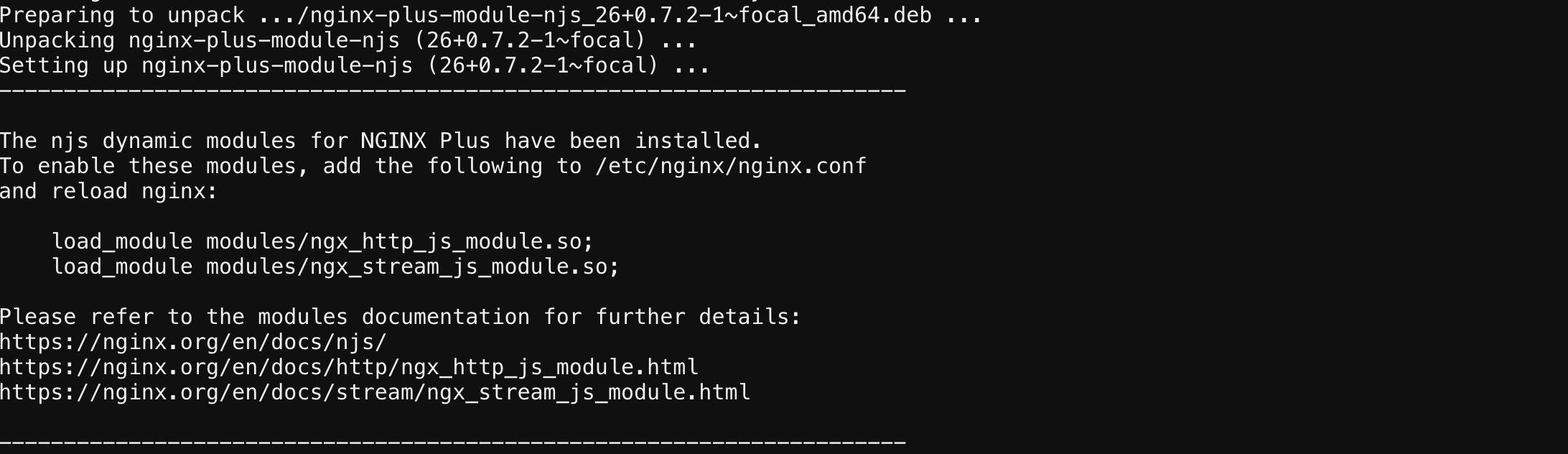
2. Verify that the modules are loaded into NGINX Plus with the below command (Use Ctrl/Shift+V to paste again).
sudo ls /etc/nginx/modulesscreenshot of expected output

- Now you will need to load the module into nginx.conf.
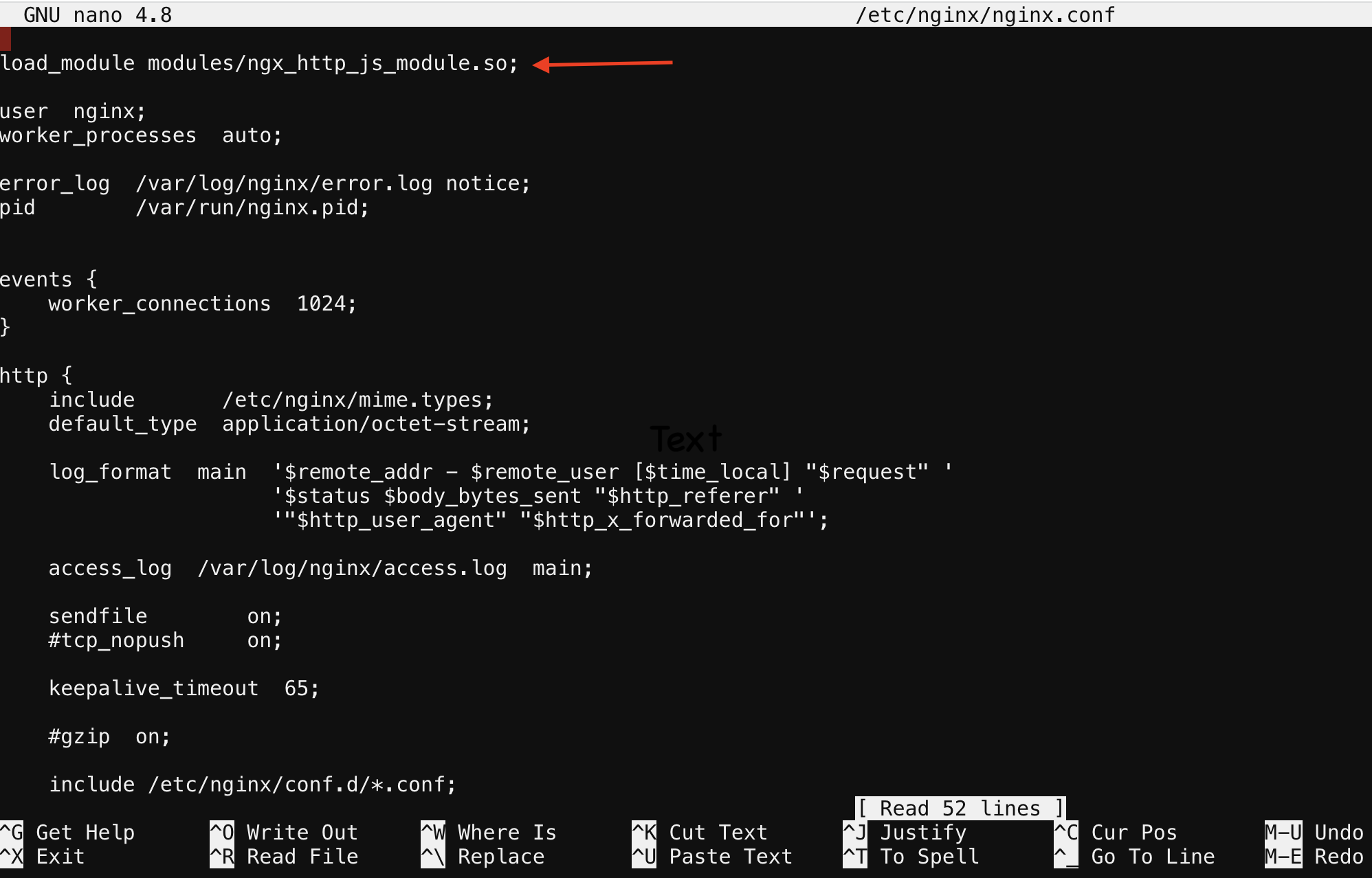
The following directive needs to be included in the top-level (“main”) configuration context in /etc/nginx/nginx.conf, to load the NGINX JavaScript module.
Copy and run below command on the NGINX 1 server to open the nano editor and select the main nginx configuration file
sudo nano /etc/nginx/nginx.conf
Below is the line of code that needs to be copied into /etc/nginx/nginx.conf file
load_module modules/ngx_http_js_module.so;
screenshot of where to place line of code
Note
To quit nano, use the Ctrl+X key combination. If the file you are
working on has been modified since the last time you saved it, you will be prompted to save the file first. Type ‘y’ to save the file then press enter to confirm
Save and exit the file
- Verify nginx config is good and reload.
verify configuration is good
sudo nginx -t
reload the nginx config
sudo nginx -s reload
Create a clone of the nginx-openid-connect GitHub repository
- Clone the branch in your home directory with the command below.
cd /home/ubuntu && git clone https://github.com/nginxinc/nginx-openid-connect.git
- Verify the clone has completed by running the following command.
ls | grep nginx-openid-connect
screenshot of output

Attention
Please do not close the UDF Shell browser tab!
Configuring the BIG-IP APM as an Authorization Server
Note
These next steps will guide you through creating a BIG-IP APM
configuration to support Nginx Plus as a client.
You will be using the BIG-IP that you previously opened in the browser.
For all objects keep default configurations except what is specified in this guide.
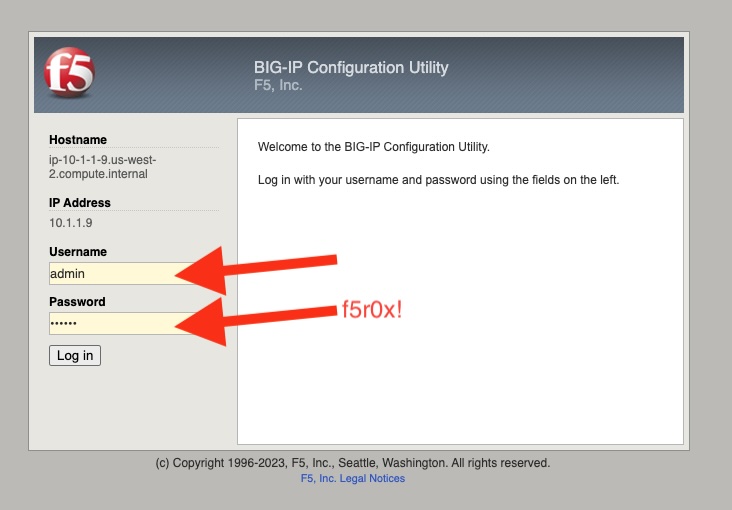
1. Open your browser tab with the BIG-IP GUI from the ‘Getting Started’ lab section and sign in using the BIG-IP username and password
Username: admin
Password: f5r0x!
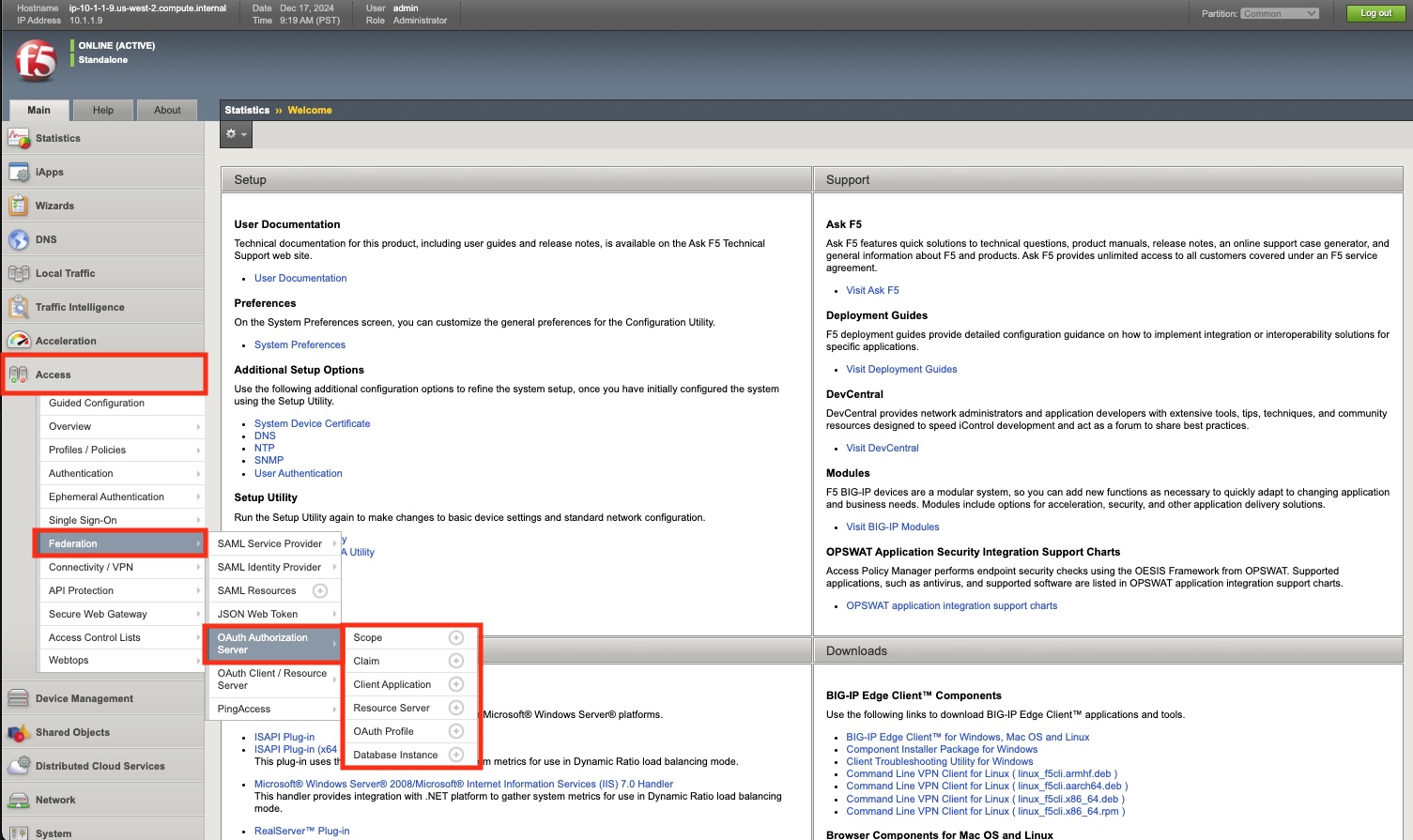
2. You should be logged into the BIG-IP now, we start with the Access > Federation > OAuth Authorization Server section
Create scopes for the Oauth/OIDC communication
Note
You will be creating two scopes: profile and email
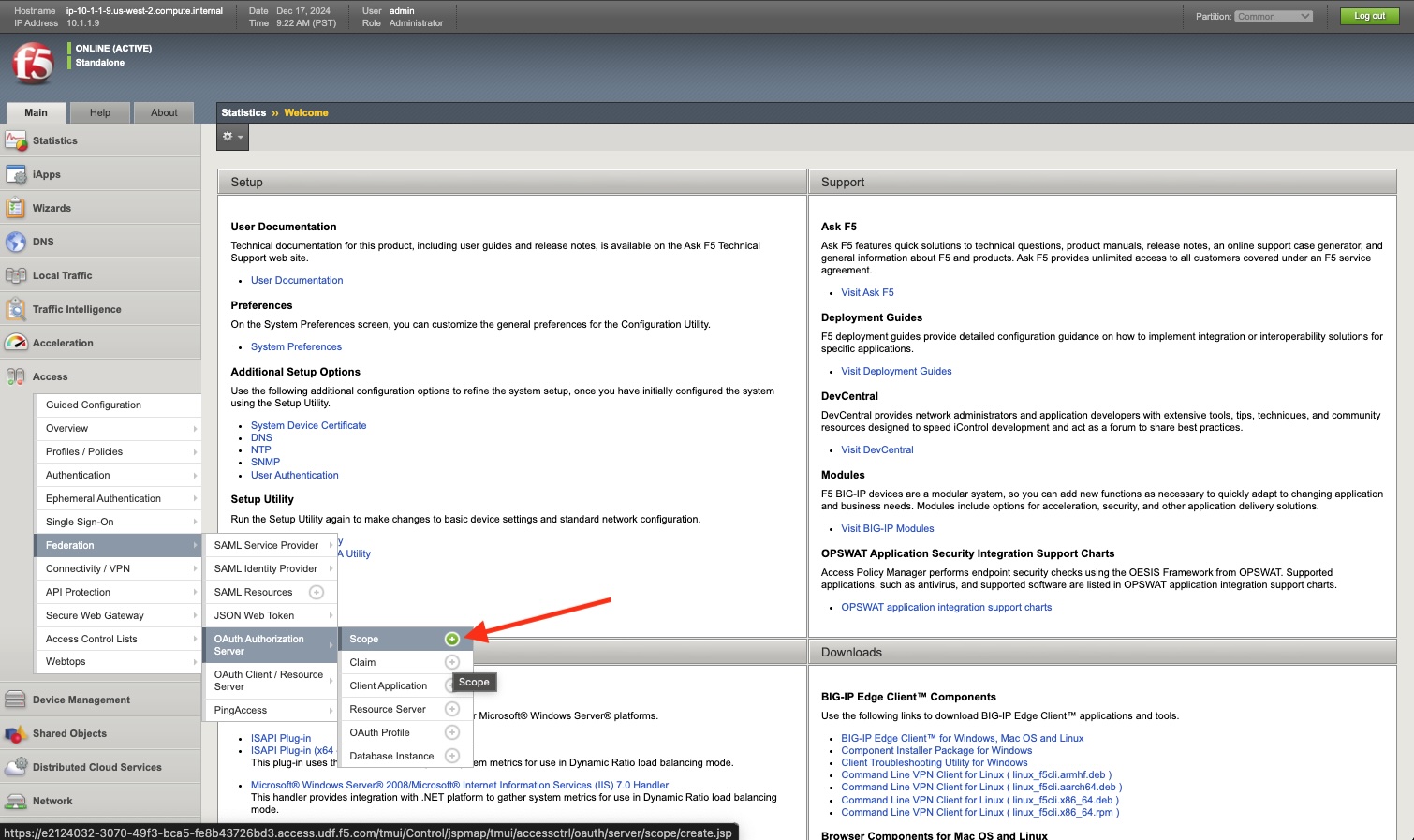
3. Navigate to Access > Federation > OAuth Authorization Server > Scope > click the + button or click create
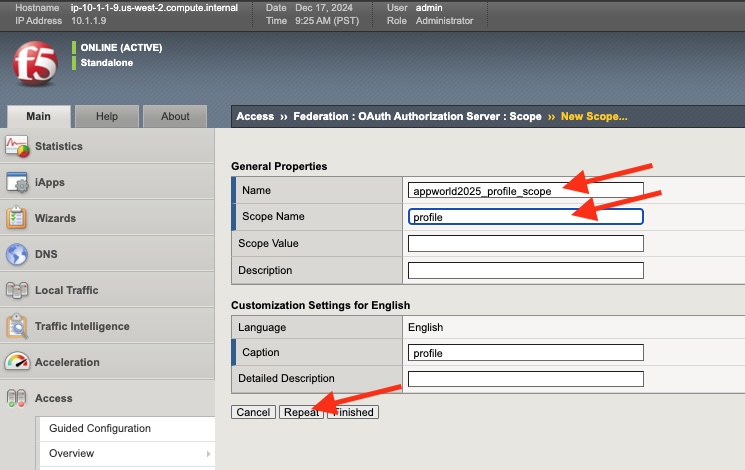
- Configure the profile scope as follows, click repeat when finished
Name: appworld2025_profile_scope
Scope Name: profile
Caption: profile
Click Repeat
5. After clicking repeat above (or click create again), enter in the information for the email scope. Be sure to update all the fields below:
Name: appworld2025_email_scope
Scope Name: email
Caption: email
Click Finished
- Click Finished at the bottom of the screen
Create claims for the Oauth/OIDC communication
Note
You will be creating two claims: profile and email
7. Navigate to Access > Federation > OAuth Authorization Server > Claim > click the + button or click create

- Configure the profile claim as follows
Name: appworld2025_profile_claim
Claim Name: profile
Claim Value: User profile information here
Click Save
- Click Save at the bottom of the screen

10. After clicking save above, click create in the top right of GUI, then repeat step 9 and 10 and use the values below .. note:
See the Claim Value below, this will automatically populate the email address of the user
Name: appworld2025_email_claim
Claim Name: email
Claim Value: %{session.logon.last.logonname}@appworld2025.com
Click Save
- Click Save at the bottom of the screen
Create the client application which is NGINX Plus in this lab
Note
This will create a client ID and client secret that will be used in the Nginx Plus configuration
12. Navigate to Access > Federation > OAuth Authorization Server > Client Application > click the + button or click create

- Configure the client application as follows, click Finished when done
Name: appworld2025_client_app
Application Name: appworld2025 Application
Grant Type: Authorization Code/Hybrid
Redirect URI(s): https://nginxdemo.f5lab.com:8010/_codexch *BE SURE TO CLICK ADD
Support OpenID Connect: Enabled Yes
Scopes: move both scopes previously created - appworld2025_email_scope & appworld2025_profile_scope
Click Finished

- Click Finished at the bottom of the screen
Create the JSON Web Token(JWT) Key configuration for the Oauth/OIDC communication
15. Navigate to Access > Federation > JSON Web Token > Key Configuration > click the + button or click create
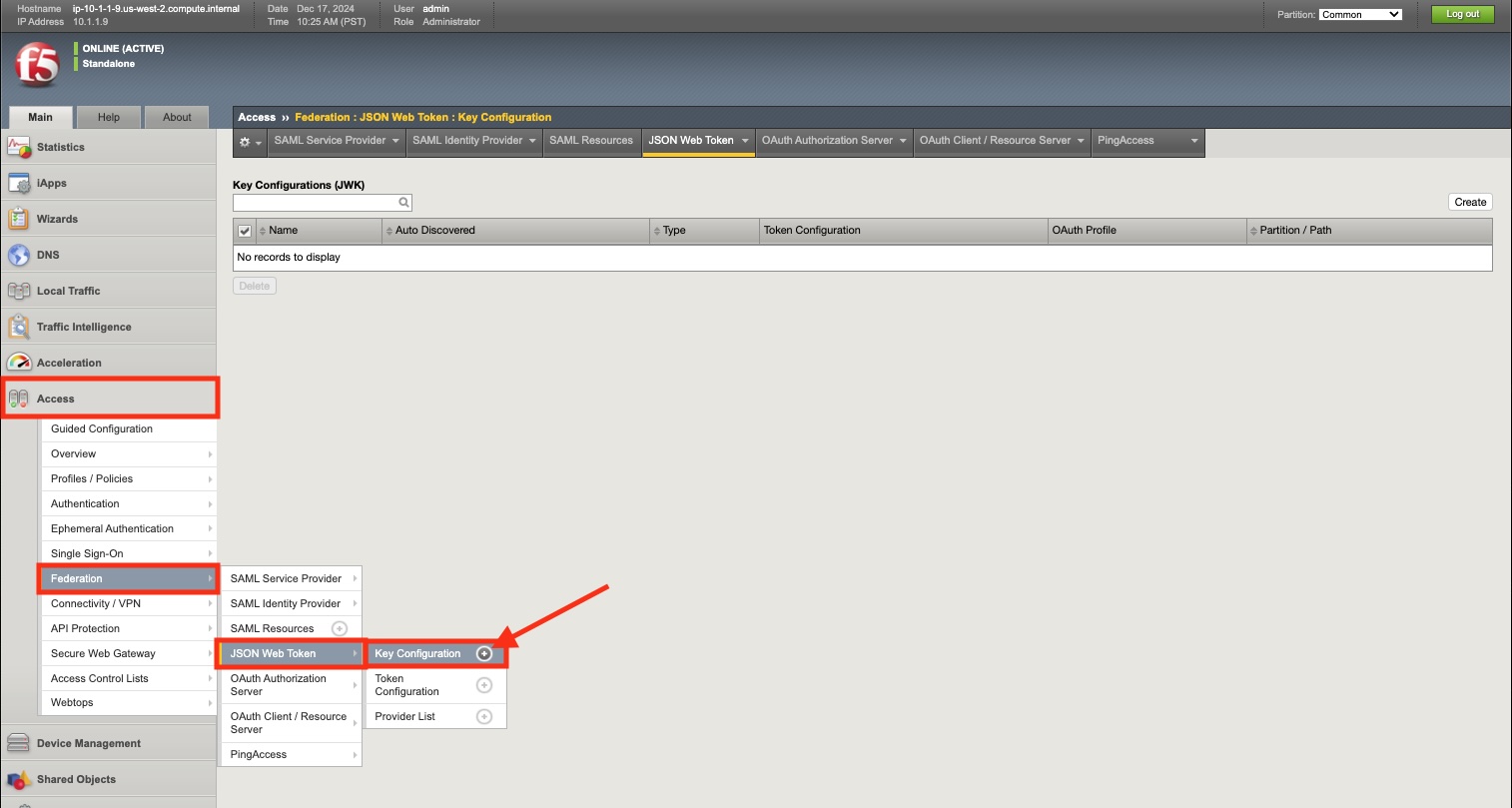
- Configure the Key Configurations as follows, click Save when finished
Name: appworld2025_jwt_key
ID: 1021
Type: RSA
Signing Algorithm: RS256
Certificate File: default.crt
Certificate Key: default.key
Click Save
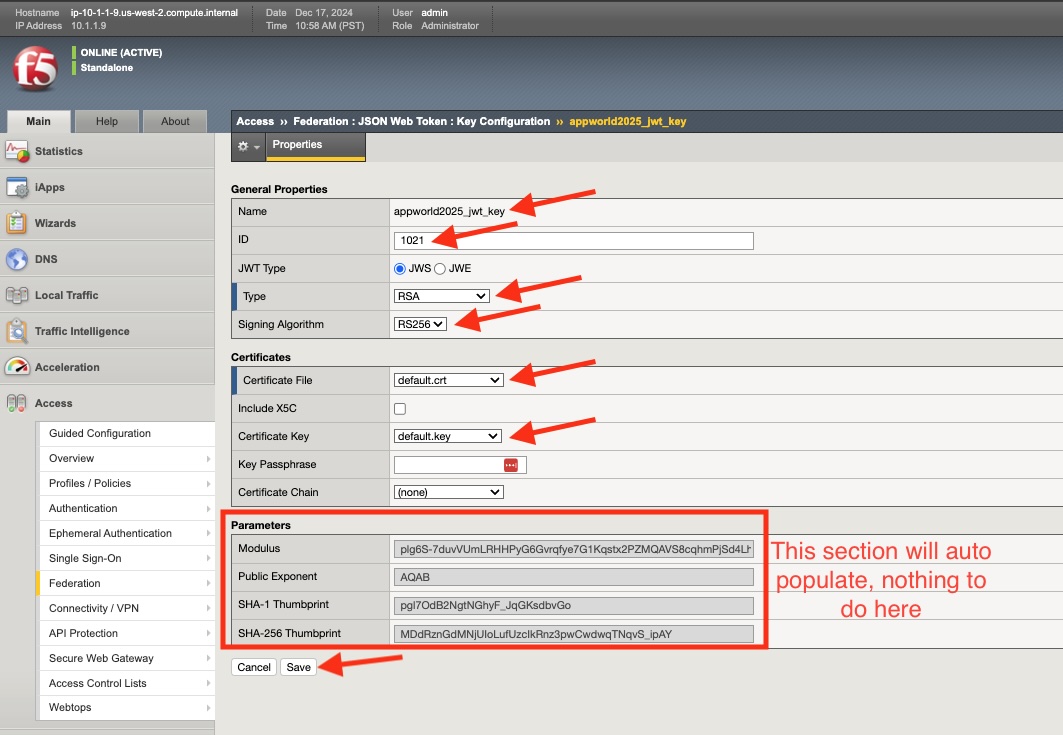
- Click Save at the bottom of the screen
Create the OAuth profile for the Oauth/OIDC communication
18. Navigate to Access > Federation > OAuth Authorization Server > OAuth Profile > click the + button or click create
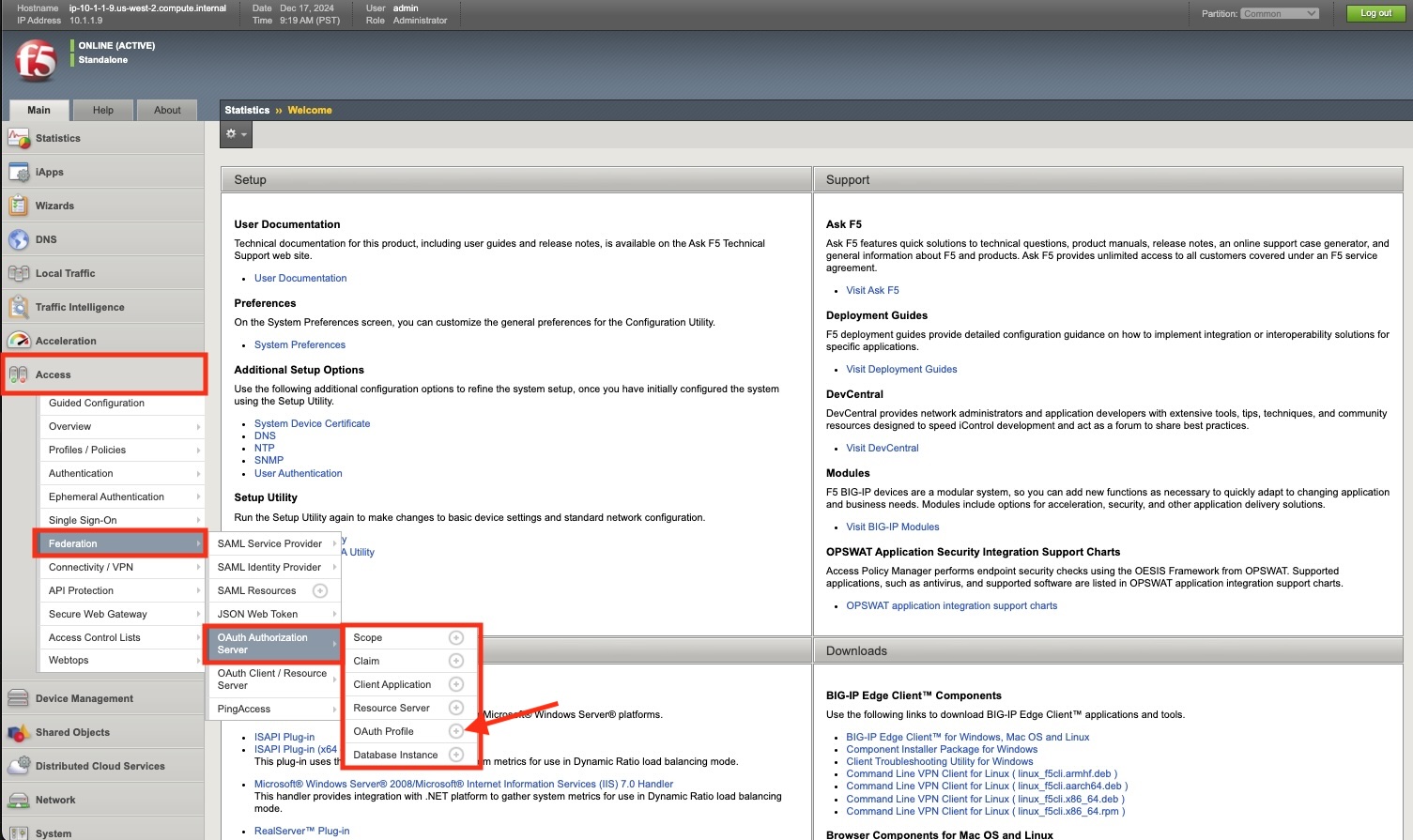
- Configure the OAuth profile as follows, click Save when finished
Name: appworld2025_oauth_profile
Client Application: appworld2025_client_app (Slide this from “Available” over to “Selected” column)
Click the Custom box on the right hand side of the screen
Support Opaque Token: Remove the check box selection
Support JWT Token: Select the check box
Support OpenID Connect: Select the check box
Issuer: https://10.1.10.9
JWT Primary Key: Select appworld2025_jwt_key
ID Token Primary Key: Select appworld2025_jwt_key
JWT Claims: Select both appworld2025_email_claim & appworld2025_profile_claim
ID Token Claims: Select both appworld2025_email_claim & appworld2025_profile_claim
JWT Refresh Token Encryption Secret: f5r0x!
Click Finished
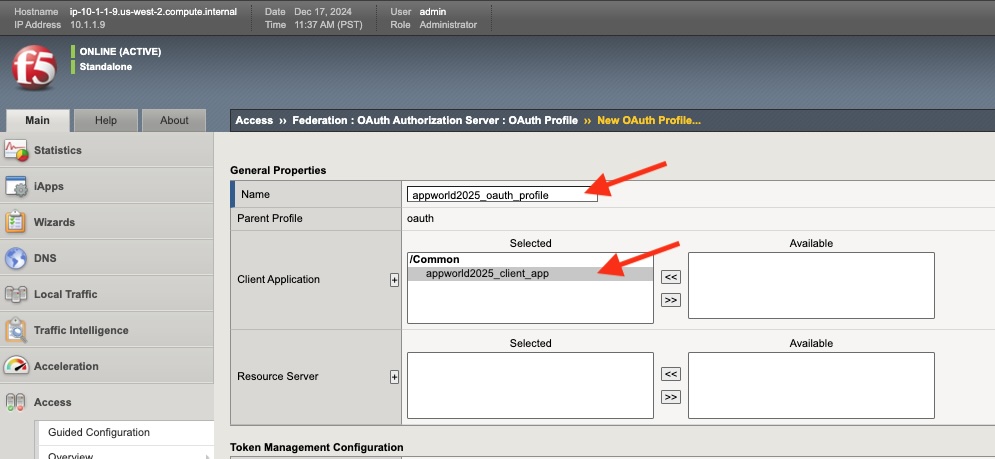

- Click Finished at the bottom of the screen
Create Local User database for the Oauth/OIDC communication
21. Navigate to Access > Authentication > Local User DB > Instances > click the + button or click Create New Instance

- Configure the User database as follows, click Ok when finished
Name: appworld2025
Click OK
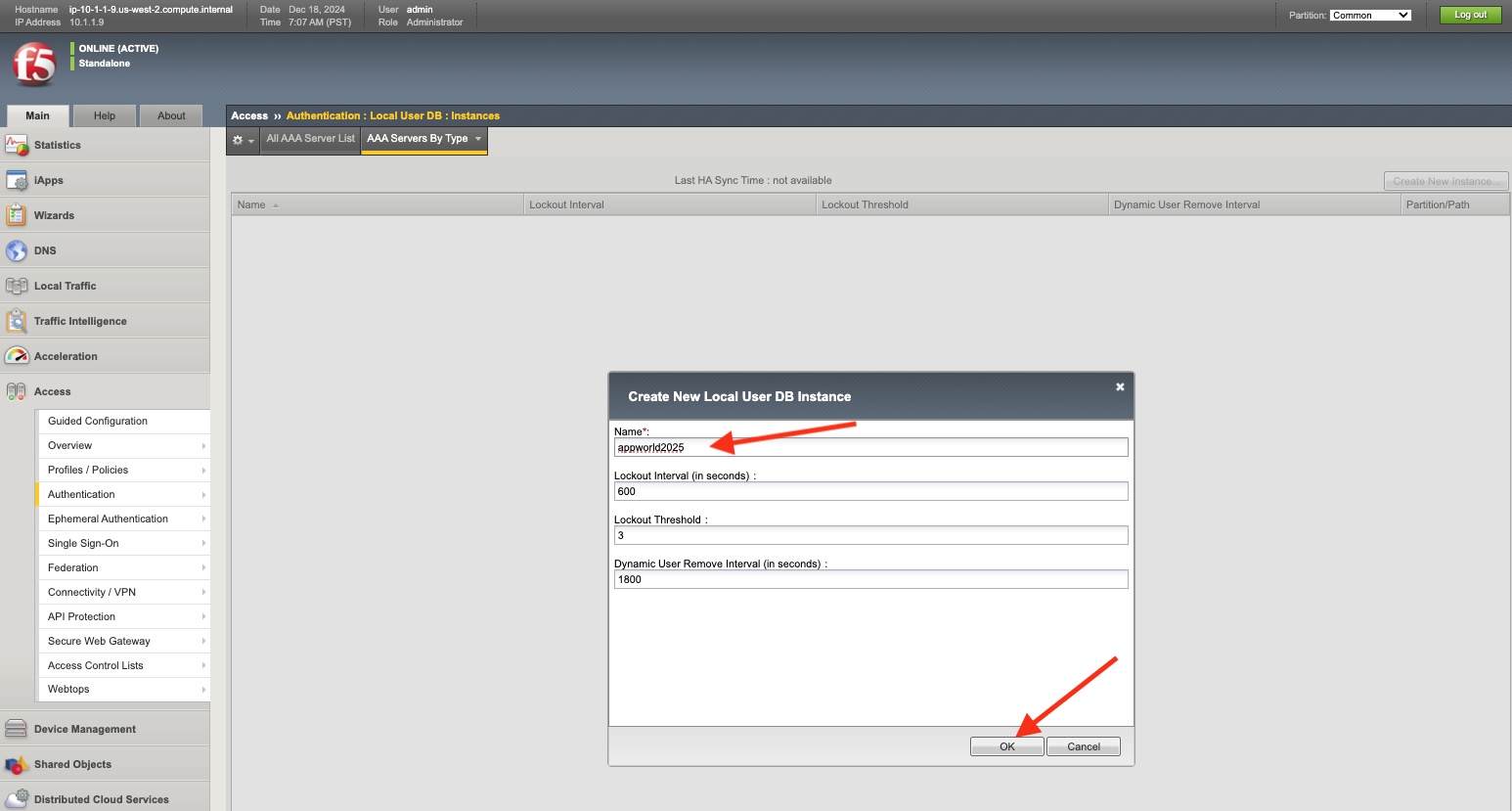
- Click Ok at the bottom of the screen
Create Local User for the Oauth/OIDC communication
24. Navigate to Access > Authentication > Local User DB > Users > click the + button or click Create New User
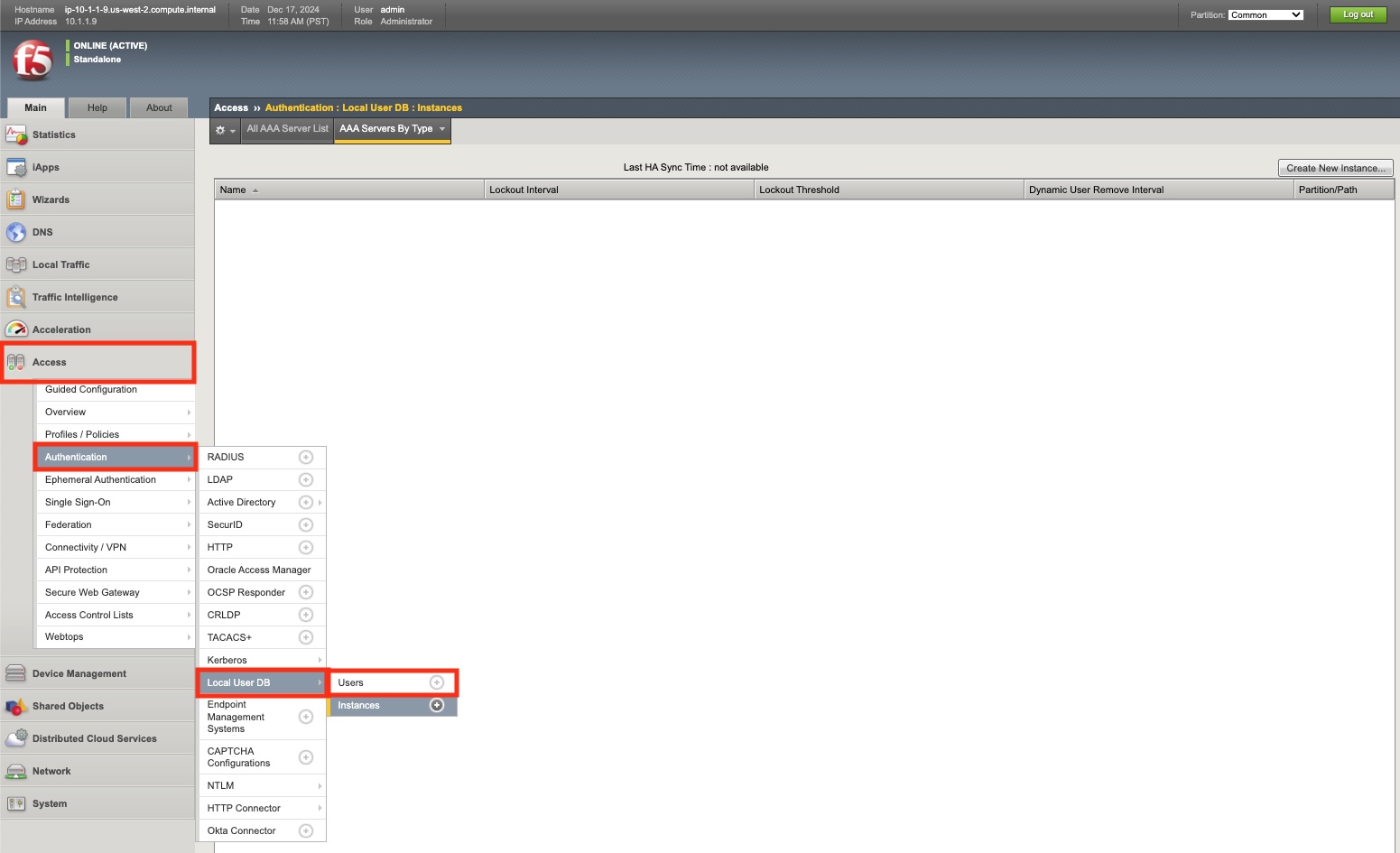
- Configure a User as follows, click Save when finished
User Name: user01
Password: appworld2025
Confirm Password: appworld2025
Click OK
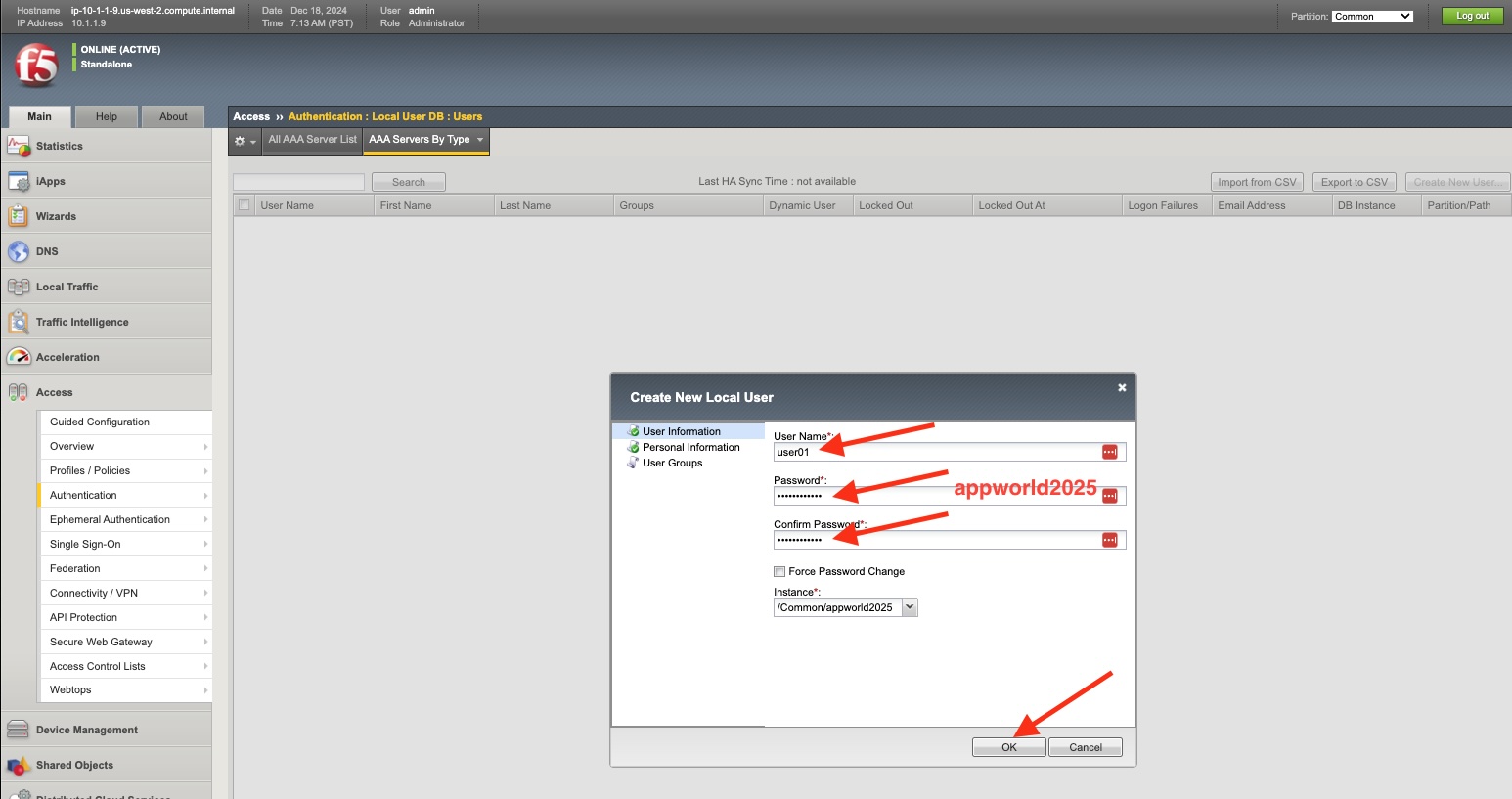
- Click Ok at the bottom of the screen
Create an Access per-session profile for the Oauth/OIDC communication
27. Navigate to Access > Profiles/Policies > Access Profiles (Per-Session Policies) > click the + button or click Create
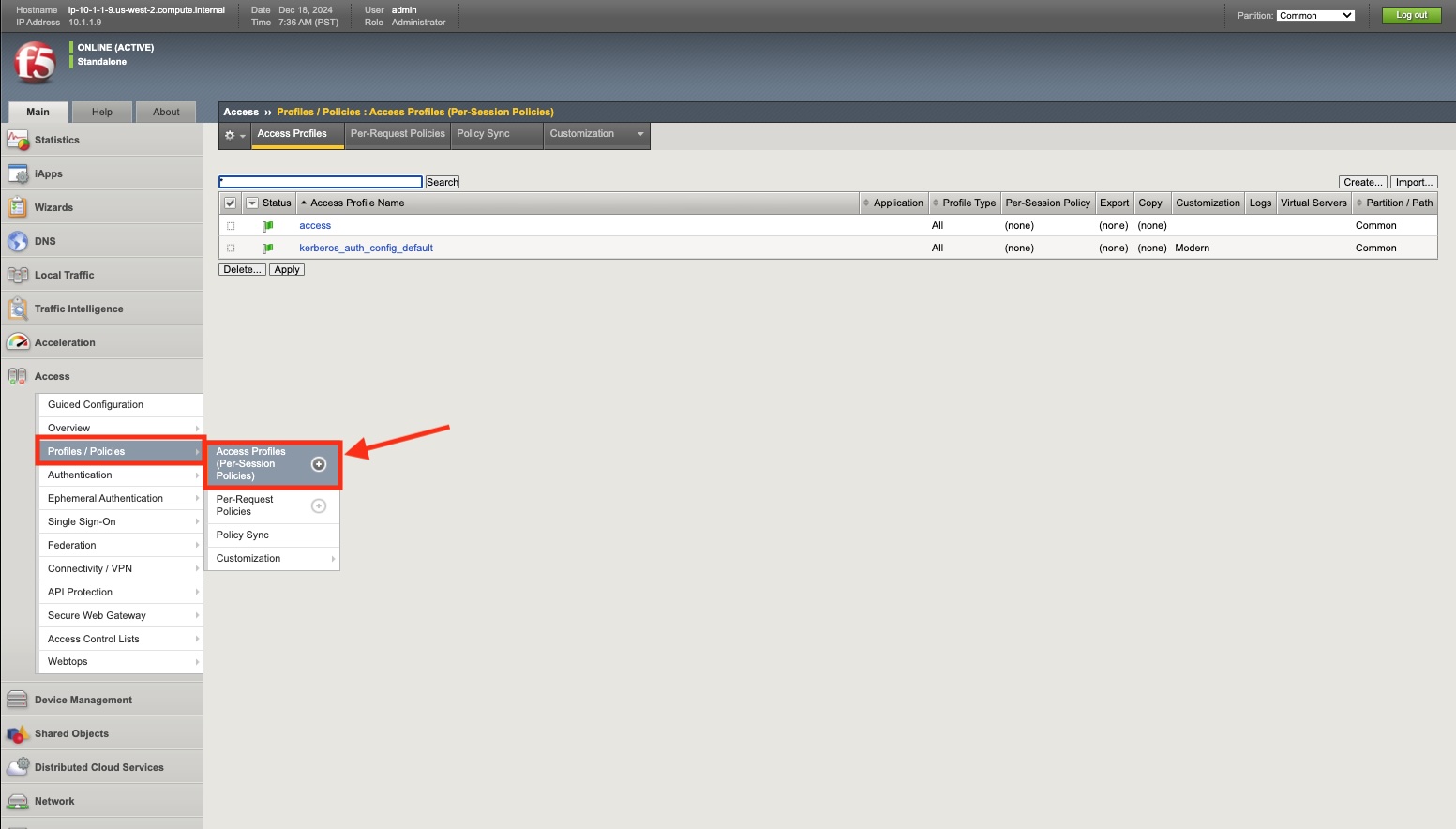
Name: appworld2025_access_profile
Profile Type: LTM-APM
OAuth Profile: appworld2025_oauth_profile
Languages: select English (en)
Click Finished
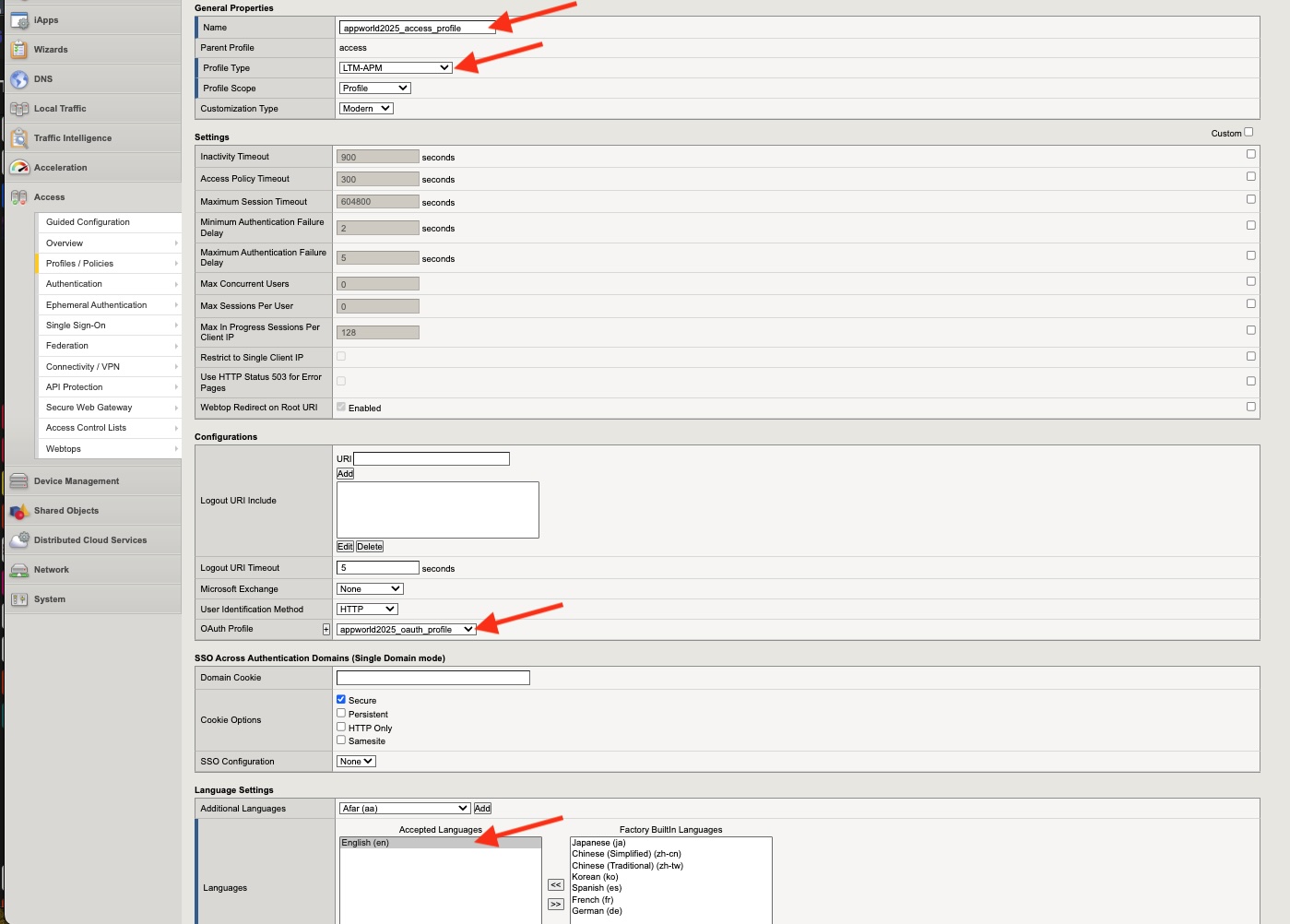
- Click Finished at the bottom of the screen
Edit Access profile per-session policy for the Oauth/OIDC communication
Note
If you exited out of the Access profiles section, navigate to Access >
Profiles/Policies > Access Profiles (Per-Session Policies)
29. Once the Access profile is created you will see it in the list of Access Profiles. Click on Edit under the tab Per-Session Policy.
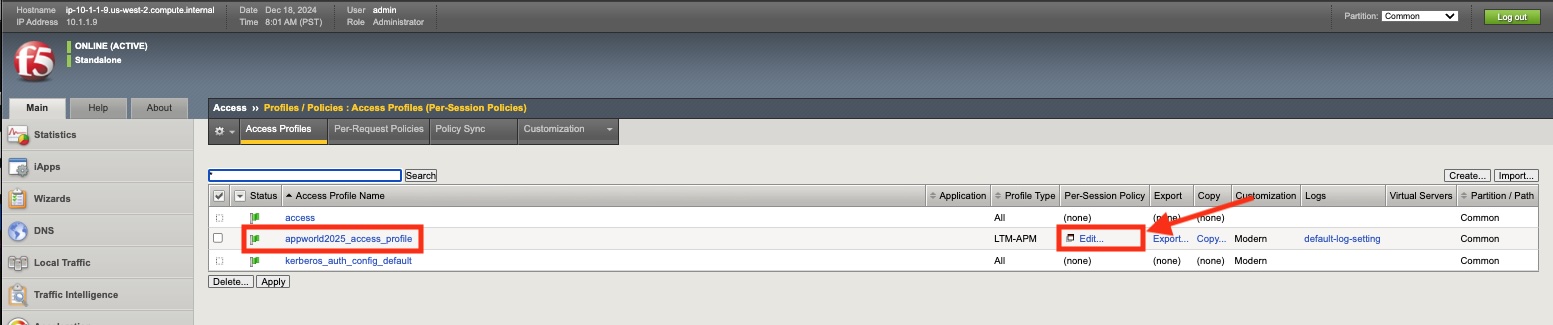
- A new browser tab will open up that should look like this:

- Click the plus sign to the right of the Start button

- In the box that pops up, select Logon Page and click Add Item

- Keep all defaults and select Save

- Click the plus sign to the right of the Logon Page you just created

- Select the Authentication tab, select LocalDB Auth, click on Add Item

36. In the field LocalDB Instance select /Common/appworld2025 and then click save

37. Click the plus sign on the successful branch to the right of the LocalDb Auth

38. Select the Authentication tab, select OAuth Authorization, click on Add Item

- Keep all defaults and select Save

- Click on the top Deny ending
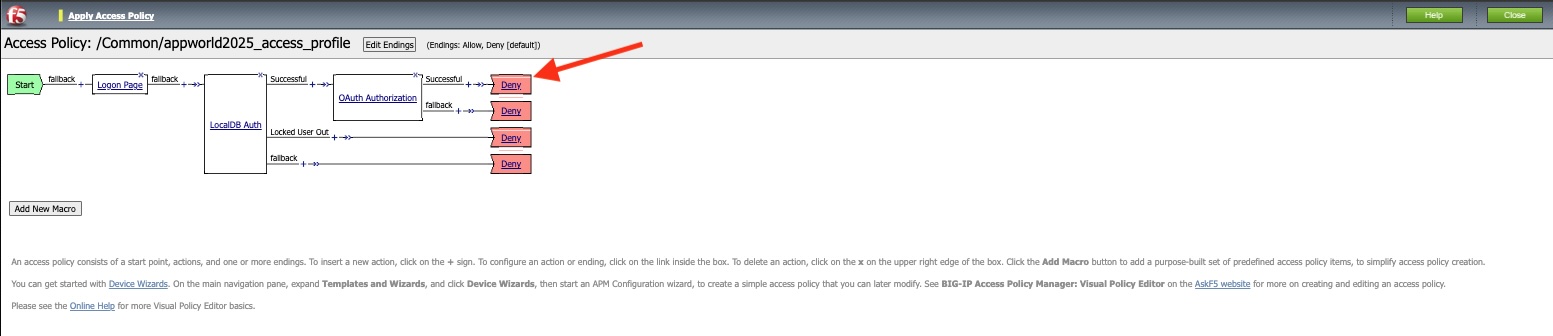
- Select Allow then click Save

- Click on Apply Access Policy in the top left of the screen, then click Close.

Create Virtual Server to support the Oauth/OIDC communication
- Return the tab where you have the BIG-IP GUI
44. Navigate to Local Traffic > Virtual Servers > Virtual Server List > click the + button or click Create
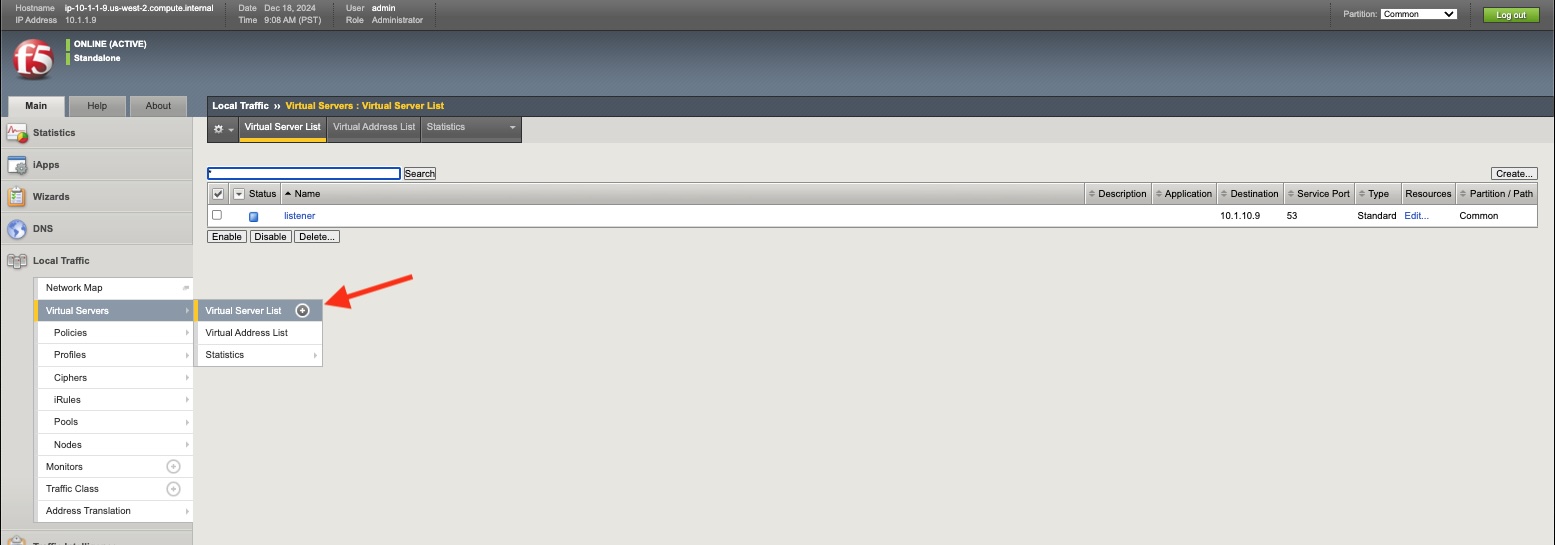
- Configure the Virtual server as follows, click Finished when done
Name: appworld2025_vip
Destination Address/Mask: 10.1.10.9/32
Service Port: 443
HTTP Profile (Client): http
SSL Profile (Client): select clientssl
SSL Profile (Server): select serverssl
Access Profile: appworld2025_access_profile
Click Finished
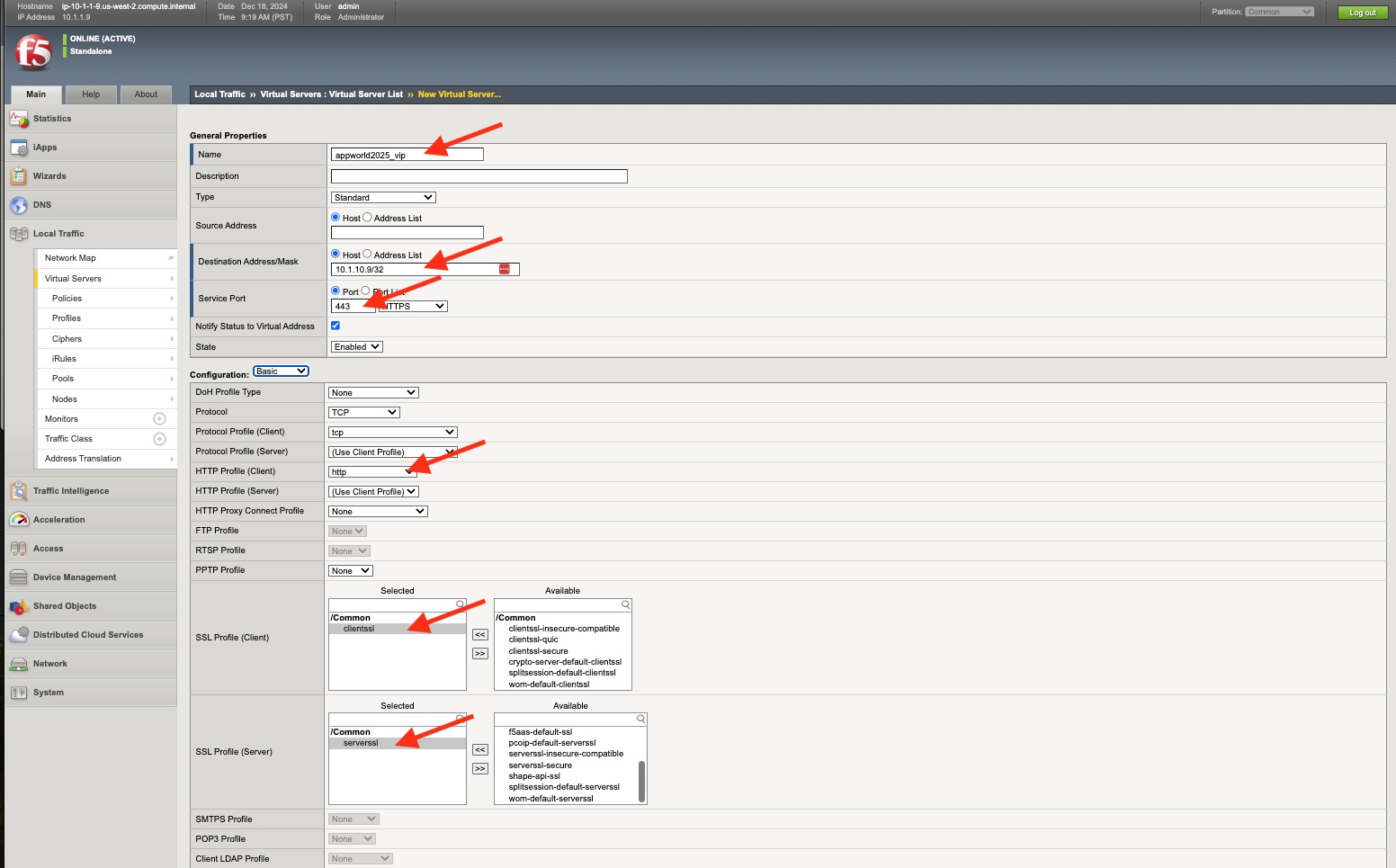
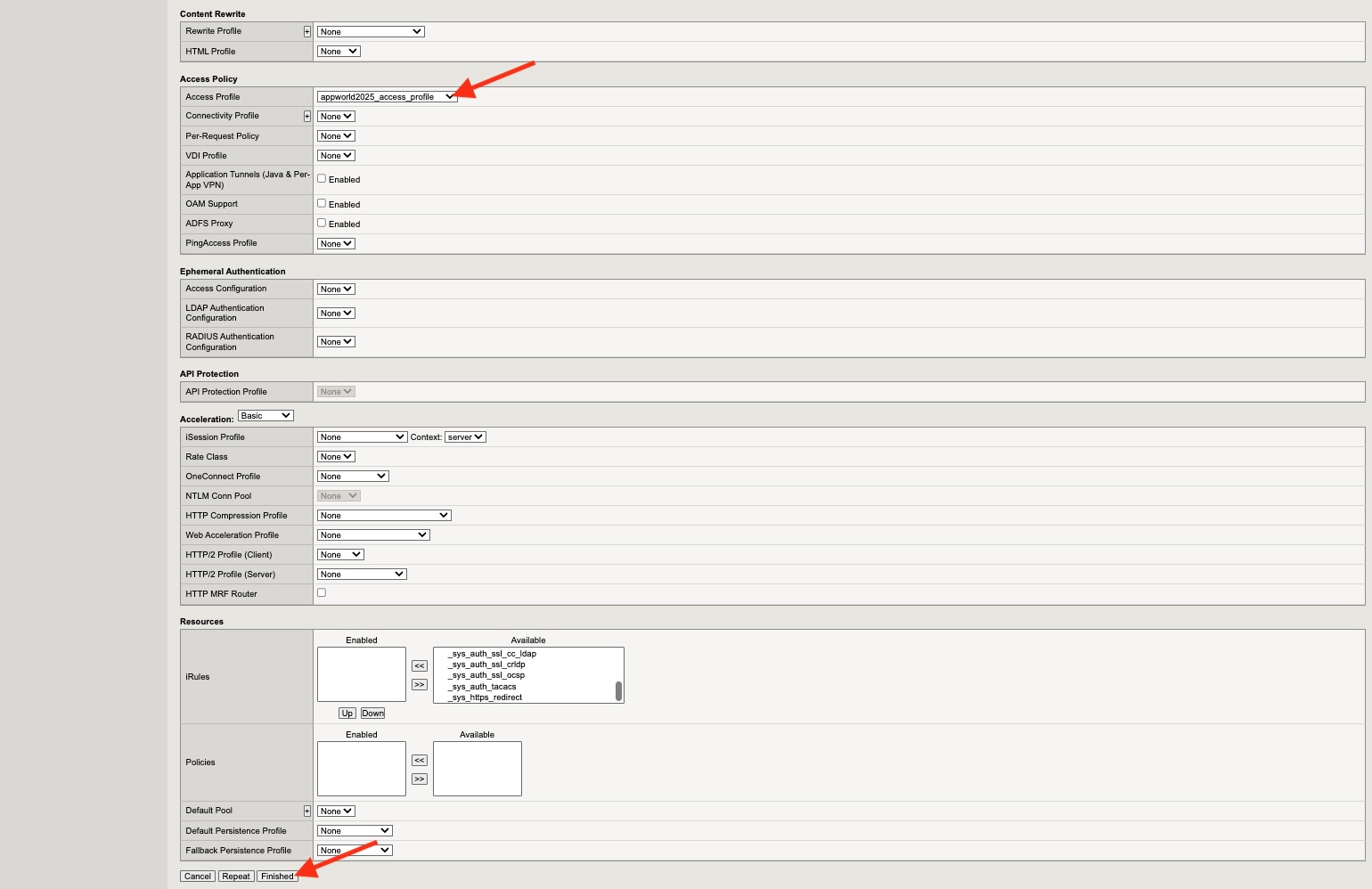
- Click Finished at the bottom of the screen
Obtain the Client ID and Client Secret generated by the BIG-IP
Note
This information will be used by Nginx Plus so the BIG-IP will trust the Nginx Plus client
You will need to store these values for future use
47. Navigate to Access > Federation > OAuth Authorization Server > Client Application then select the previously created client application “appworld2025_client_app”

48. You will need the following two values to input into your Nginx Plus configuration; the Client ID and Secret.
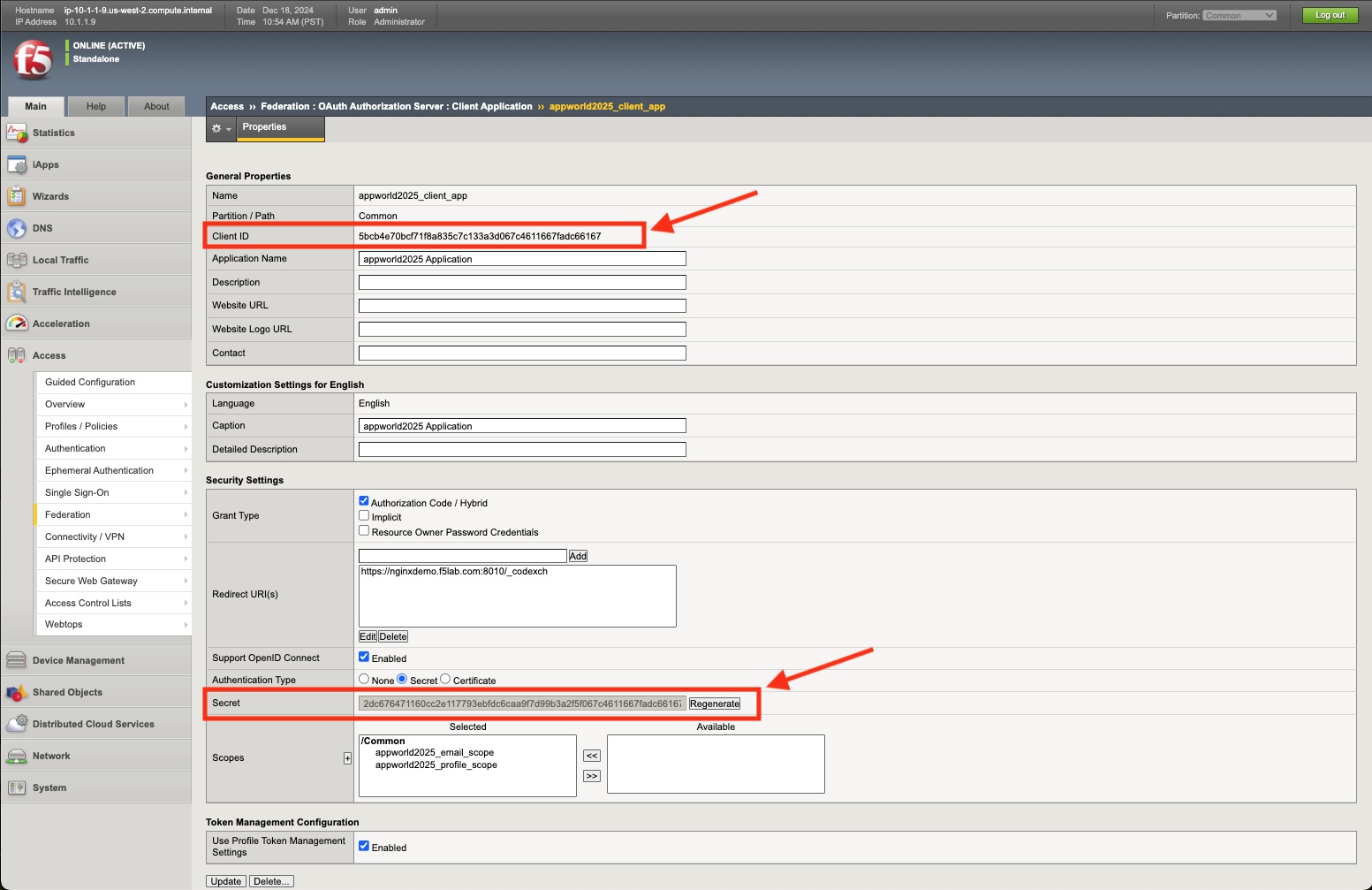
Attention
You are finished with configuring the BIG-IP.
Please do not close the BIG-IP browser tab, you will need to use it again.
Configure NGINX Plus as the OpenID Connect relying party
1. Now go back to the NGINX 1 UDF Shell browser tab that you have open. You are going to run a configuration script.
Please copy and paste the below command into the webshell DON’T FORGET TO REPLACE THE CLIENT ID AND SECRET FOR THE CODE BELOW (use the ‘Client Secret’ note that you made earlier to help build the correct command syntax).
YOURCLIENTID: <get_from_bigip>
YOURCLIENTSECRET: <get_from_bigip>
./nginx-openid-connect/configure.sh -h nginxdemo.f5lab.com -k request -i <YOURCLIENTID> -s <YOURCLIENTSECRET> -x https://10.1.10.9/f5-oauth2/v1/.well-known/openid-configuration
screenshot of output

Note
Information on switches being used in script:
echo ” -h | –host <server_name> # Configure for specific host (server FQDN)”
echo ” -k | –auth_jwt_key <file|request> # Use auth_jwt_key_file (default) or auth_jwt_key_request”
echo ” -i | –client_id <id> # Client ID as obtained from OpenID Connect Provider”
echo ” -s | –client_secret <secret> # Client secret as obtained from OpenID Connect Provider”
echo ” -p | –pkce_enable # Enable PKCE for this client”
echo ” -x | –insecure # Do not verify IdP’s SSL certificate”
- Change Directory.
cd ./nginx-openid-connect/
3. Now that you are in the nginx-openid-connect directory, use the provided command to copy the below files.
frontend.conf openid_connect.js openid_connect.server_conf openid_connect_configuration.conf
cp frontend.conf openid_connect.js openid_connect.server_conf openid_connect_configuration.conf /etc/nginx/conf.d/
- After copying files change directory to ‘/etc/nginx/conf.d/’.
cd /etc/nginx/conf.d/
- Using Nano edit the ‘frontend.conf’ file.
nano frontend.conf
6. Update the upstream server and update the listen directive to add ssl capabilities, as shown in the screenshot below:
server 10.1.1.4:8081;
listen 8010 ssl; # Use SSL/TLS in production
server_name nginxdemo.f5lab.com;
ssl_certificate /etc/nginx/selfsigned.crt;
ssl_certificate_key /etc/nginx/selfsigned.key;
ssl_protocols TLSv1.2 TLSv1.3;
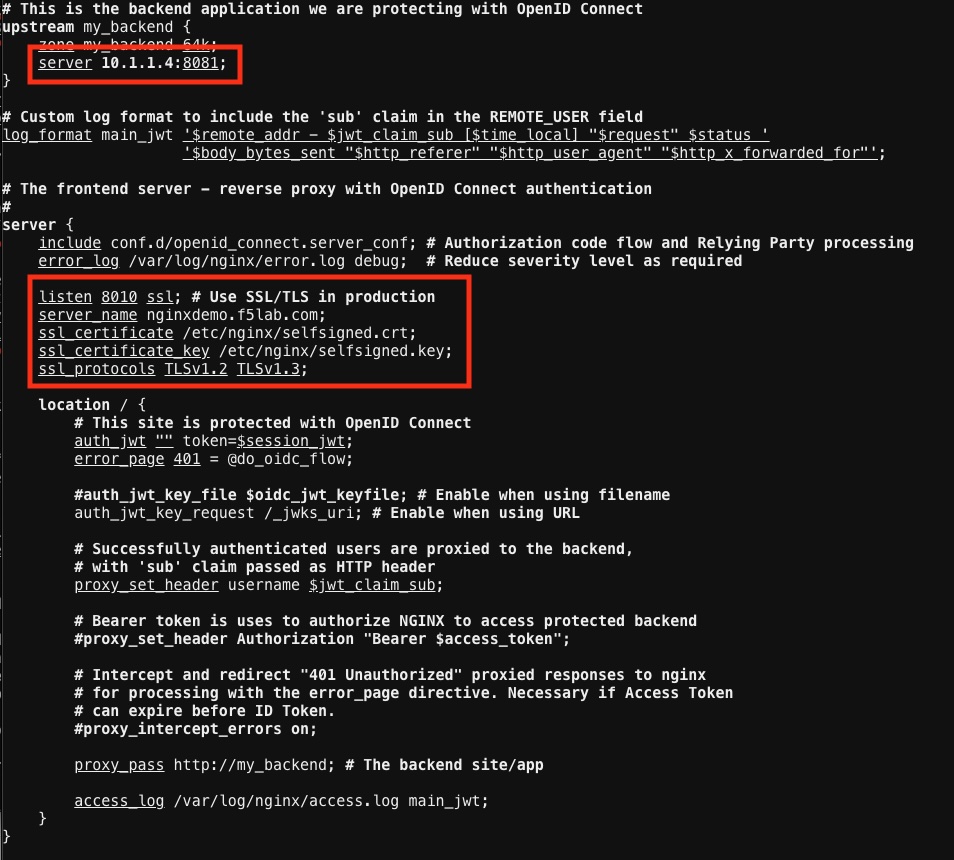
save file and close file
- Using Nano edit the ‘openid_connect.server_conf’ file.
nano openid_connect.server_conf
- Update the resolver to use local host file as shown below.
resolver 127.0.0.53; # For DNS lookup of IdP endpoints;
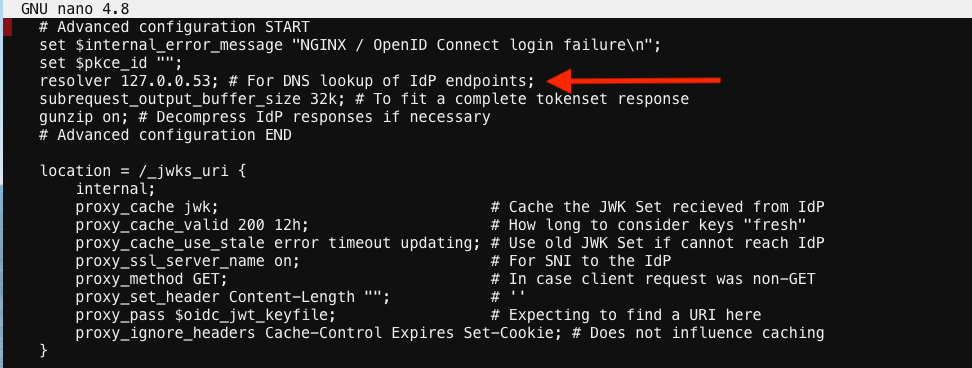
save and close file
Note
We are using the host file because this is a lab, so make sure to put in the LDNS server for the resolver
- Using Nano edit the openid_connect_configuration.conf.
nano openid_connect_configuration.conf
10. Scroll down and modify the $oidc_authz_extra_args section, add the following above the default entry. See screenshot for example.
nginxdemo.f5lab.com "token_content_type=jwt";
screenshot of output

Scroll down further and modify the $oidc_jwt_keyfile section, add the following above the default entery. See screenshot for example.
nginxdemo.f5lab.com "https://10.1.10.9/f5-oauth2/v1/jwks";
screenshot of output

Scroll down further and modify the $oidc_client_secret from 0 to “YOURCLIENTSECRET” from the earlier step, See screenshot for example. Do not forget to add the quotation marks!
screenshot of output
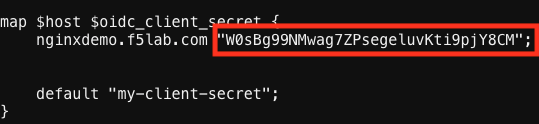
Scroll down further and add the keyword “sync” to the first three ‘keyval_zone’ variables at the bottom of the file, so that it looks like below.
screenshot of output
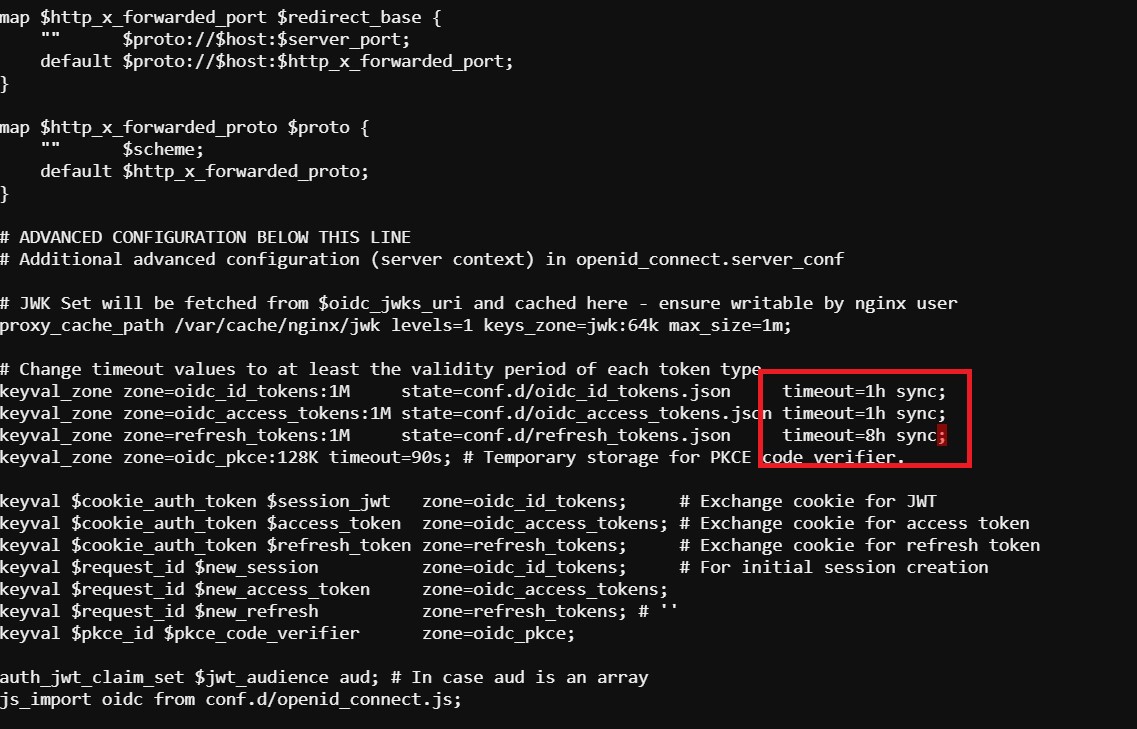
save and close file
- Reload Nginx.
nginx -s reload
Note
Please leave the NGINX 1 server webshell connection open!
Testing the config
Now that everything is done lets test the config! Please go back to the Firefox tab on your local browser.
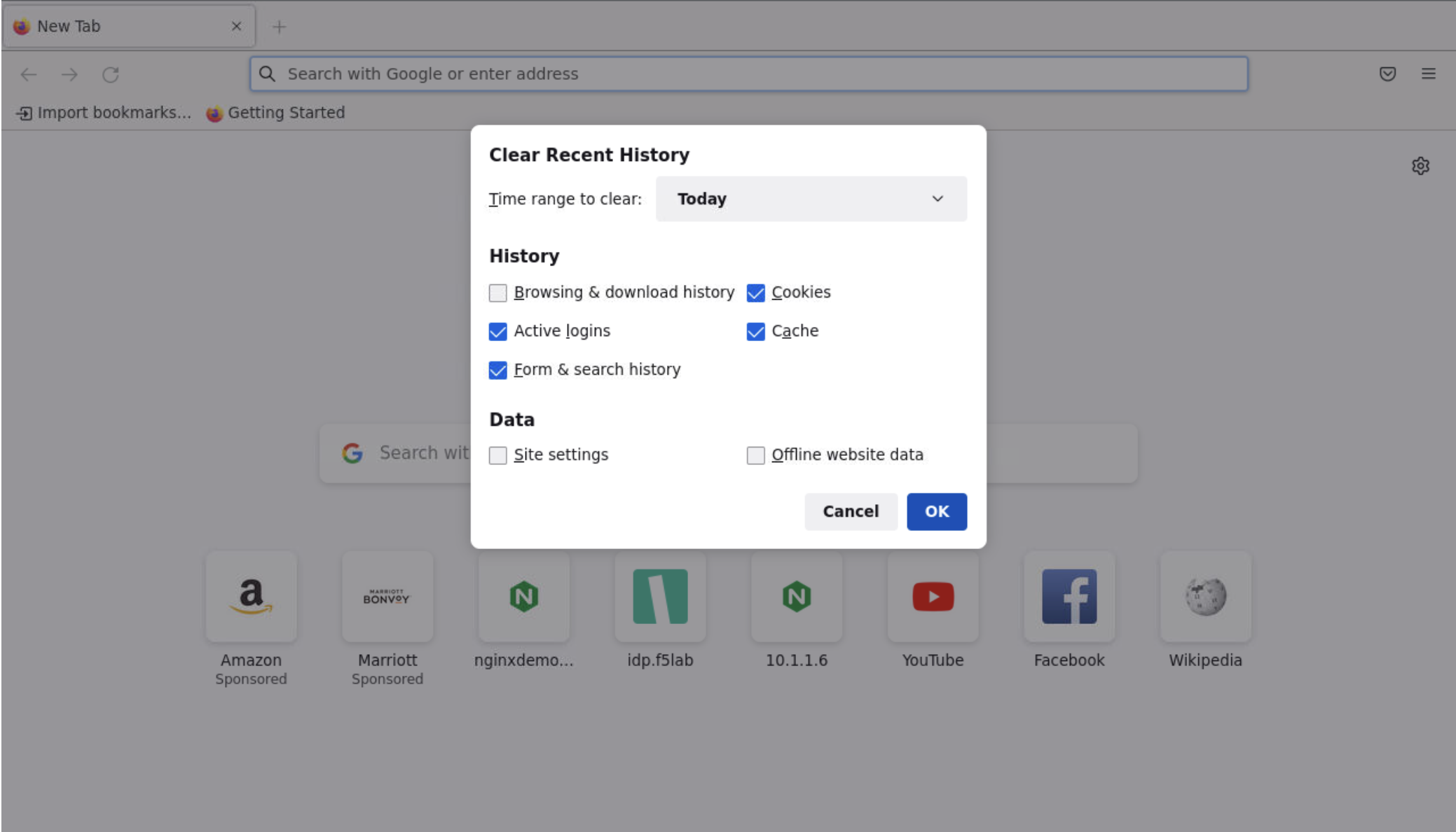
1. Clear recent history and cookies from the browser (under Privacy & Security on the Firefox Settings tab).
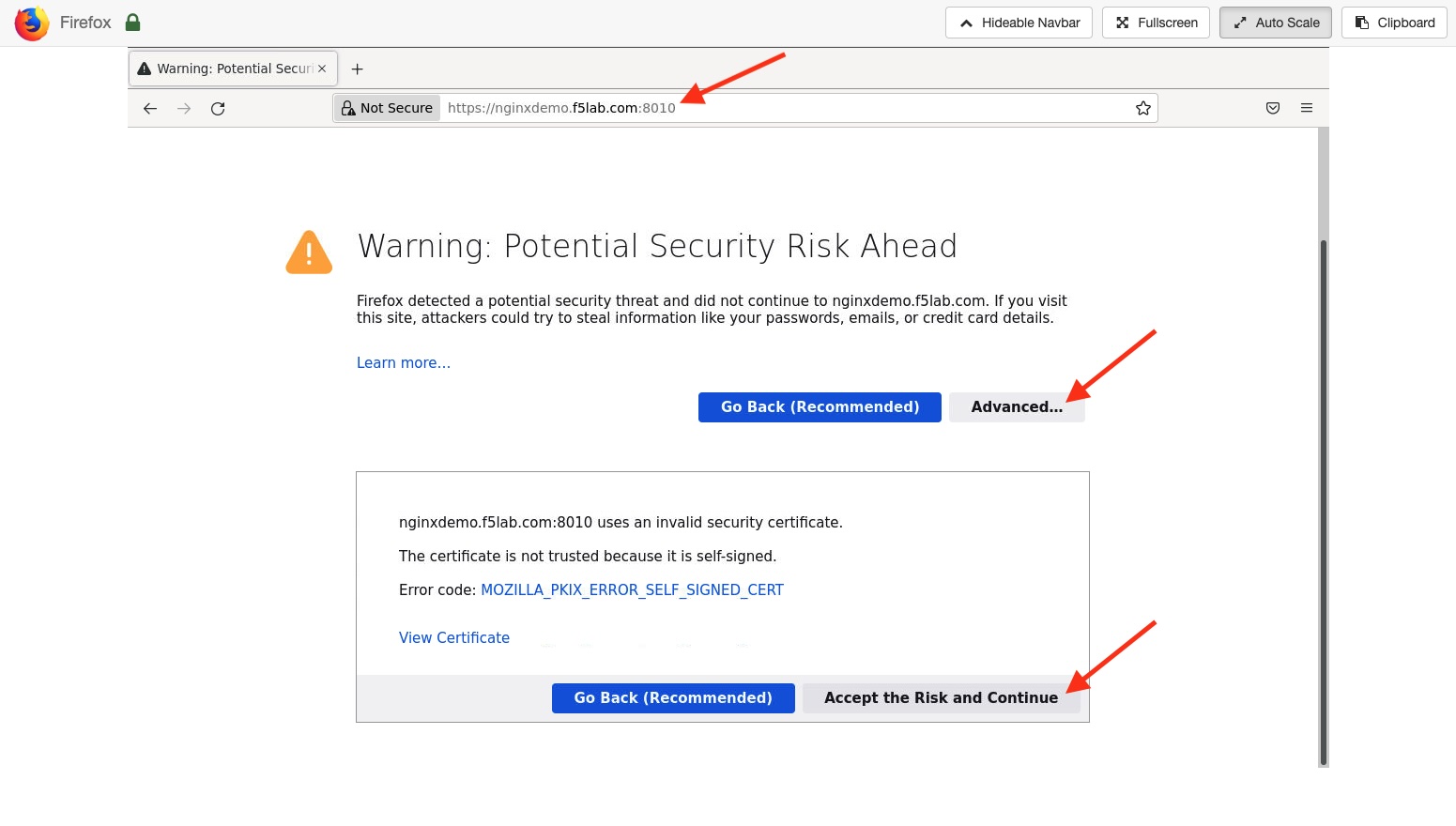
2. While still in Firefox, open a new tab and type https://nginxdemo.f5lab.com:8010 into the browser and launch the page.

3. You will get a Warning message because we are using the self-signed certificate. Hit Advanced then Accept the Risk and Continue
Notice you’ll be redirected to the IdP for login, the IdP in this case is the BIG-IP APM.
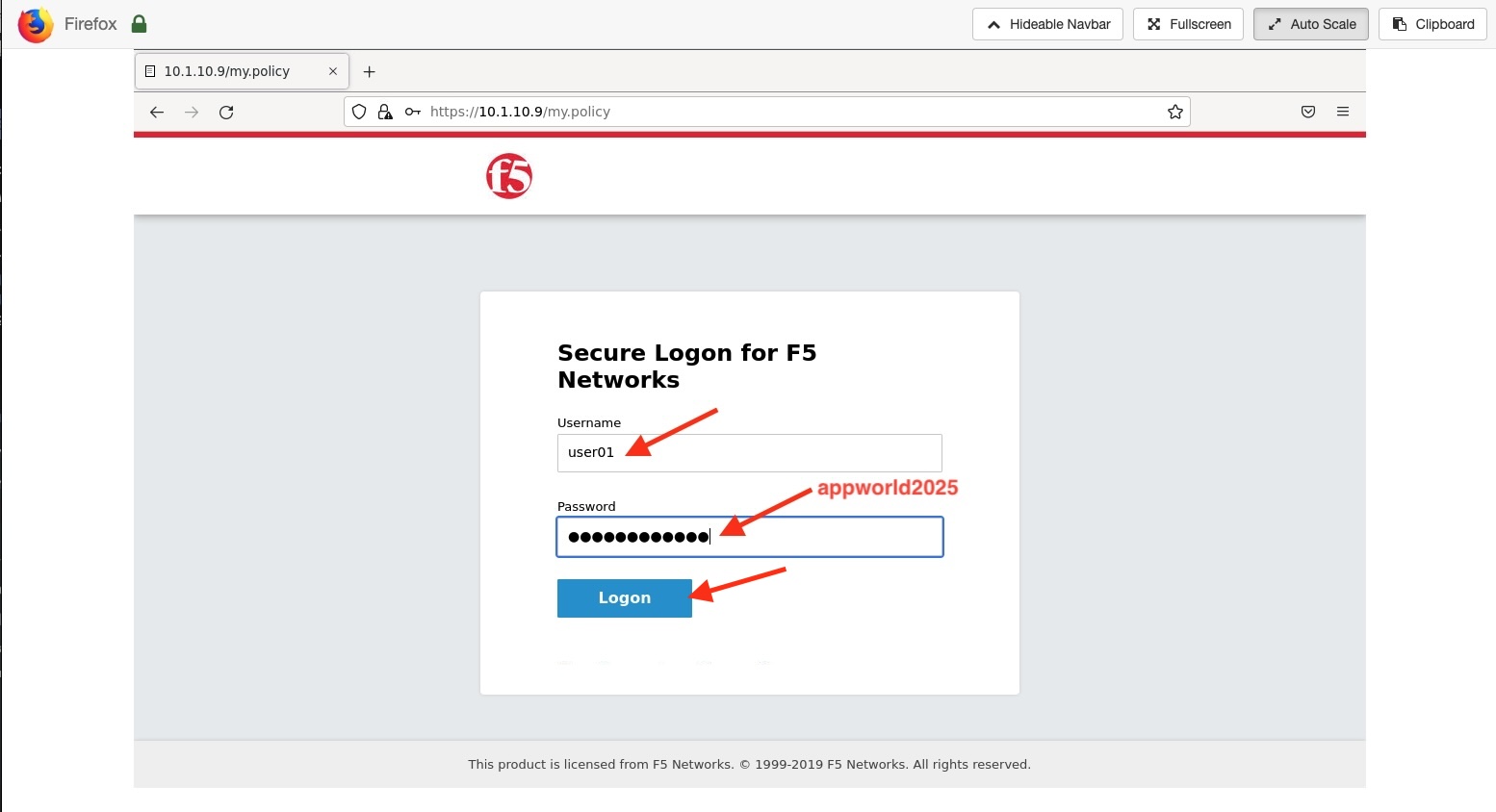
4. Once on the IdP page put in the credentials for the user you created. user01 with password appworld2025 (do not save the credentials, if prompted). Click Logon
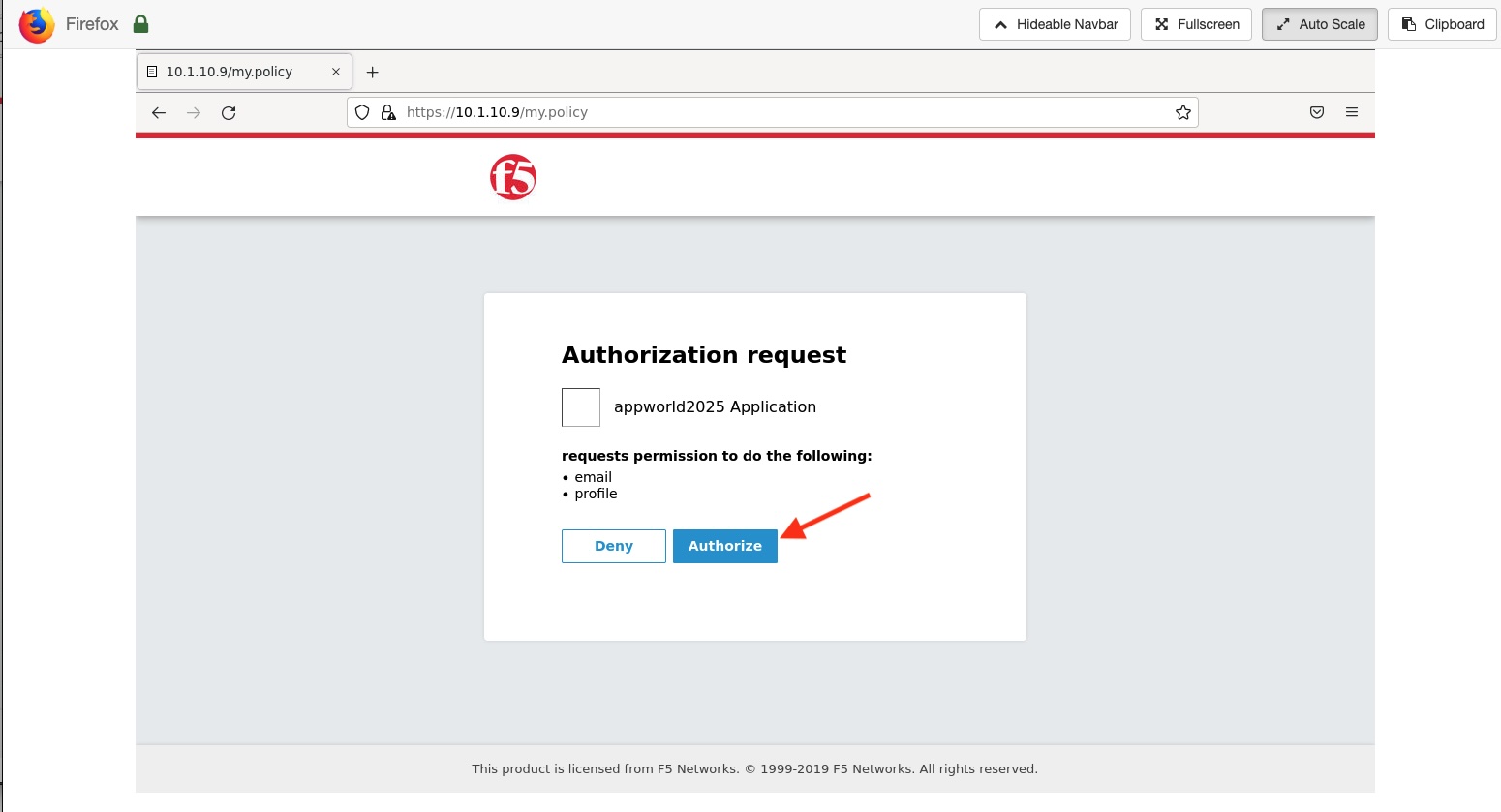
5. You’ll now get a page that asks you if you authorize providing your profile information and email address. Click Authorize.
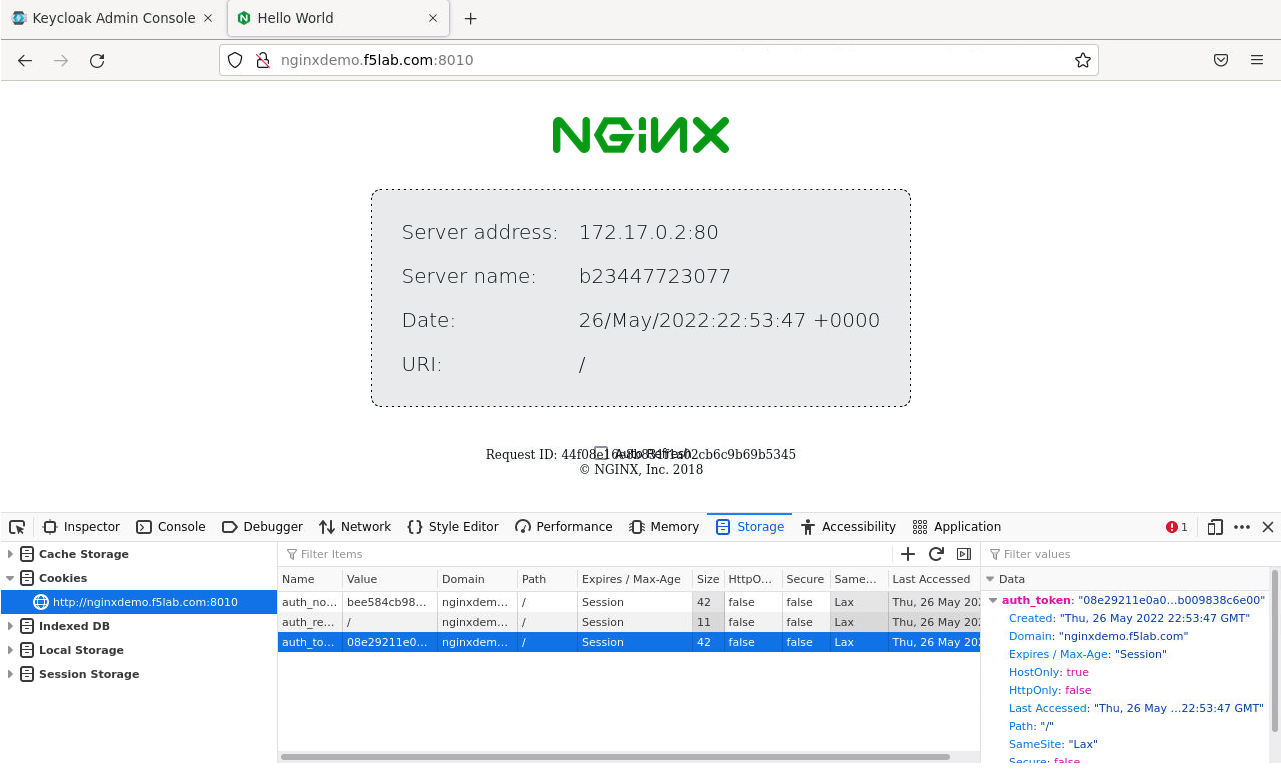
You should now see the webservice! You’ve been logged in and the browser has been issued a JWT Token establishing identity! You can view the token by clicking ‘More tools’ and ‘Web Developer Tools’ in the Firefox Settings menu, then selecting the ‘Storage’ tab and highlighting “auth_token”.
Manage NGINX Plus with Instance Manager
The OIDC authentication is working correctly. Now we will manage our NGINX Plus deployment with Instance Manager.
1. Open a new tab in Firefox and put https://nim.f5lab.com into the browser url field and launch the page (accept the risk and continue).
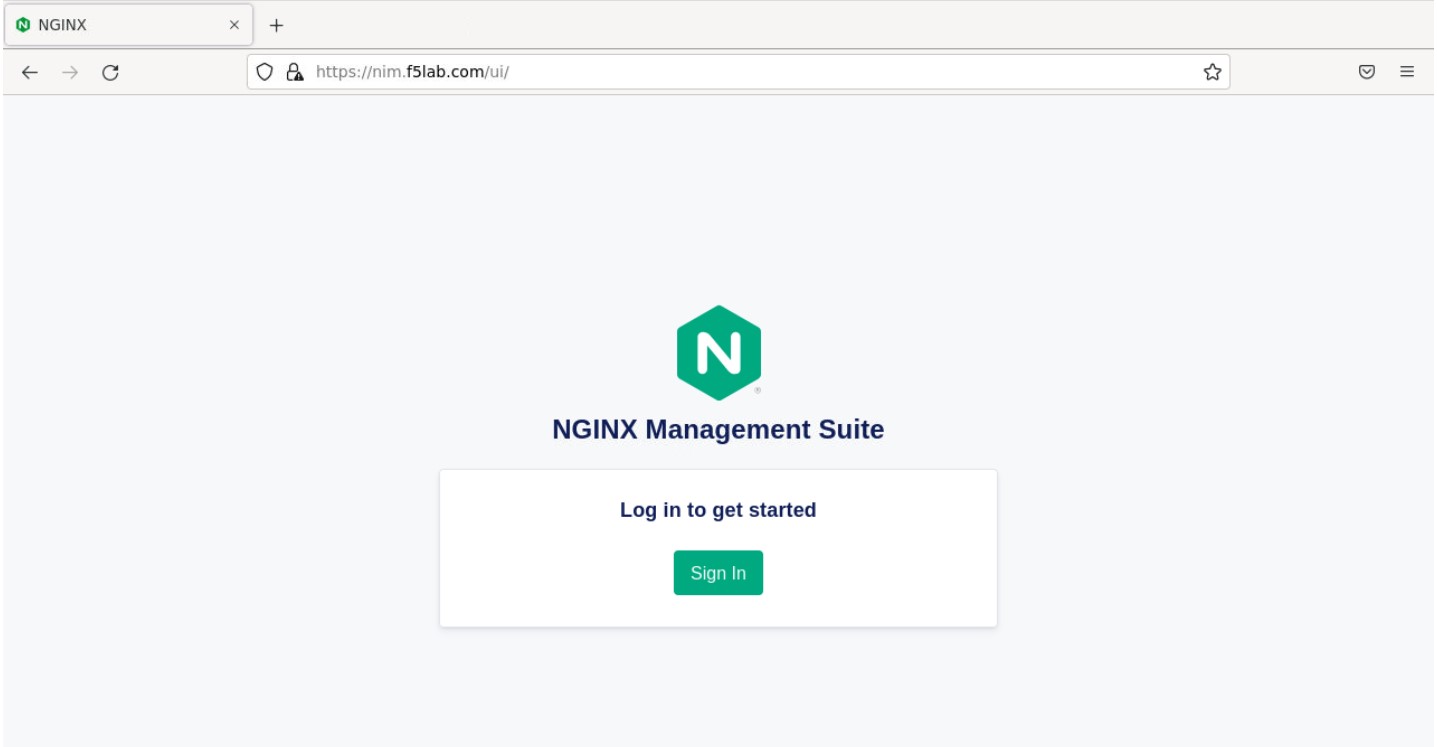
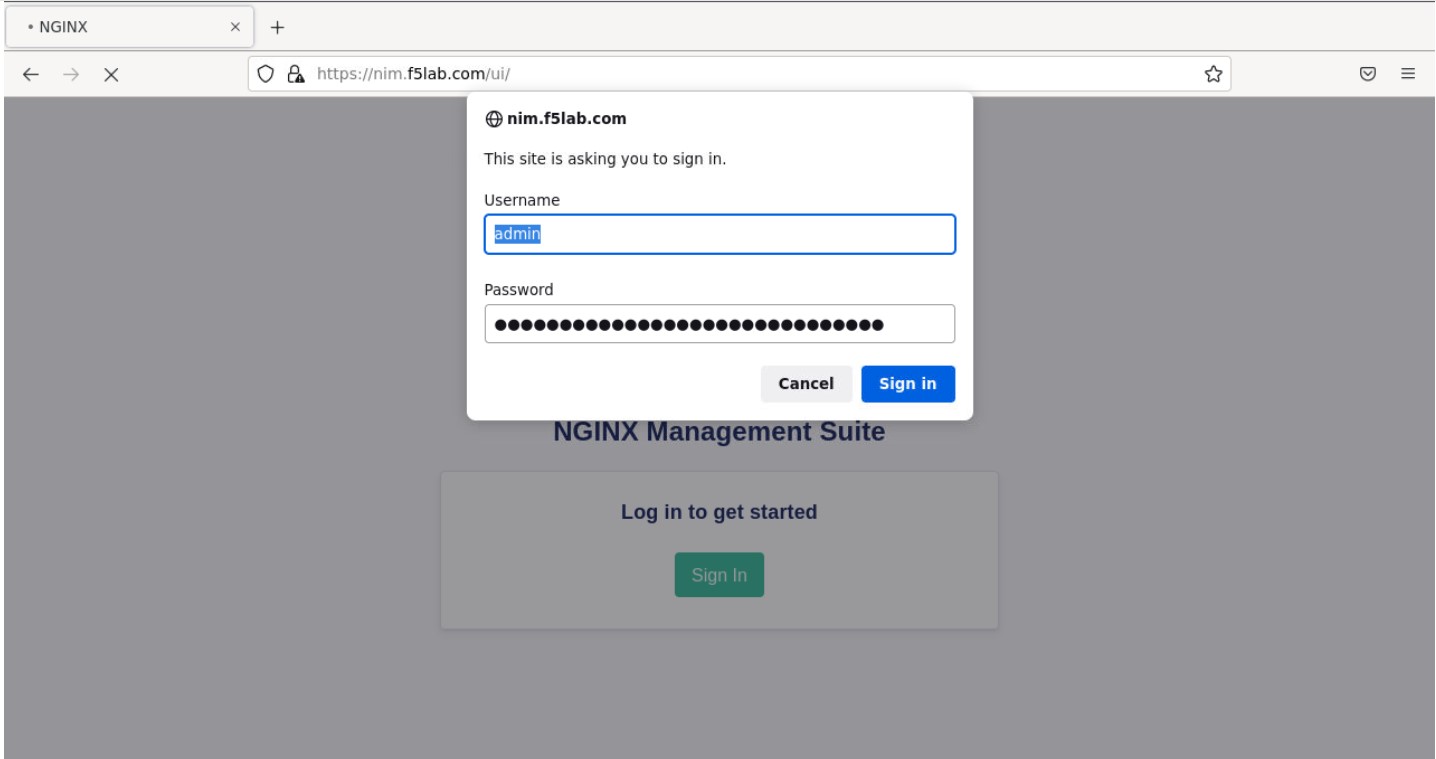
2. Sign into Instance Manager as admin. The username/password are saved in the browser so the fields should autopopulate.
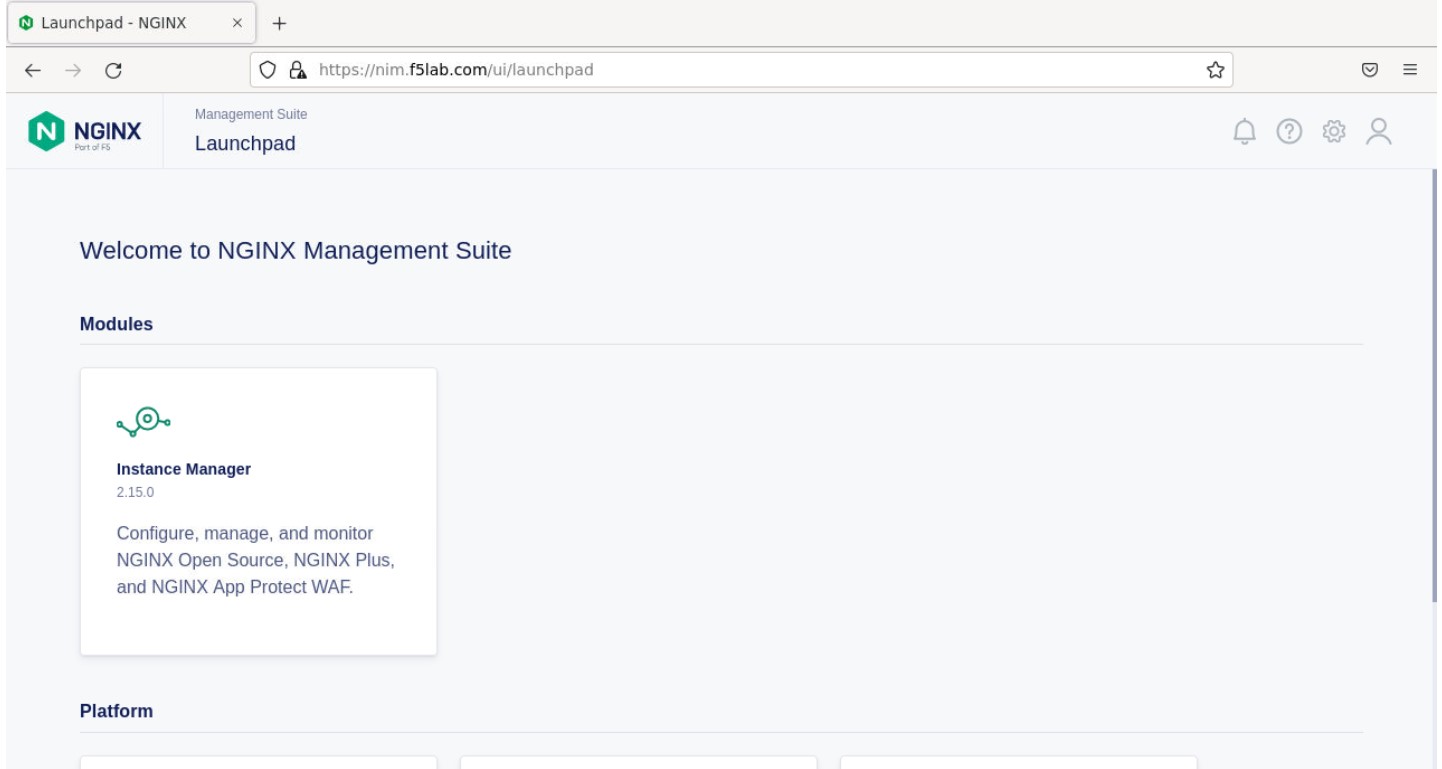
- Once you are signed in, click on the ‘Instance Manager’ module.
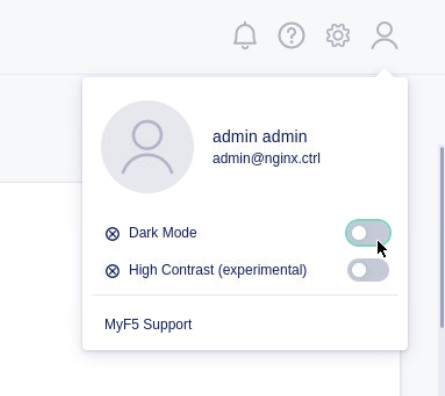
Note
If you prefer the ‘Dark Mode’ interface, select it from the ‘Account’
menu in the upper right corner of the page
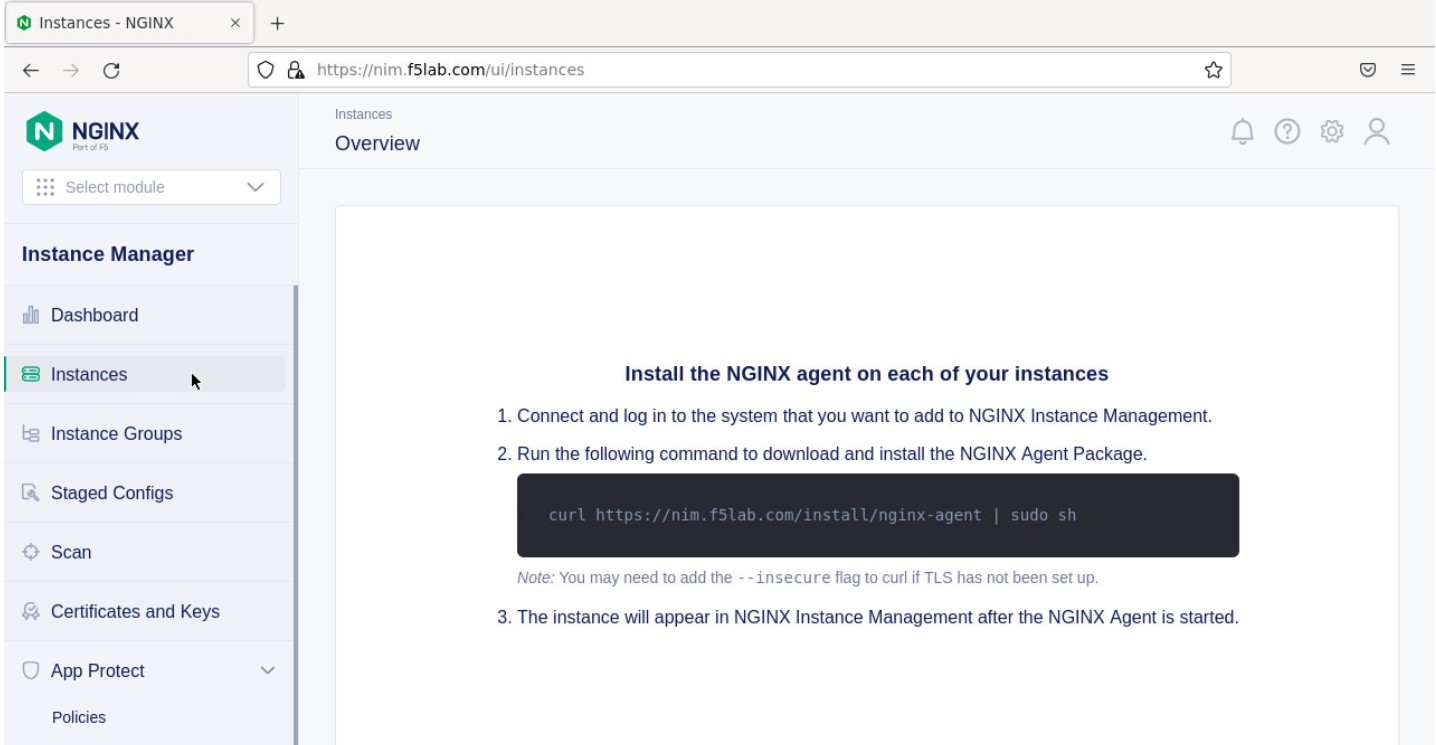
4. Once directed to main console page of NGINX Instance Manager, click on ‘Instances’ and you will see the instructions on how to add NGINX instances to Instance Manager.
5. Change to home directory and copy/run the below command on the NGINX 1 server to install the agent and add the NGINX 1 server to the ‘default’ instance group.
cd ~ && curl -k -O  https://nim.f5lab.com/install/nginx-agent
sudo sh nginx-agent --instance-group default
- Once the installation is complete, start the nginx agent.
sudo systemctl start nginx-agent
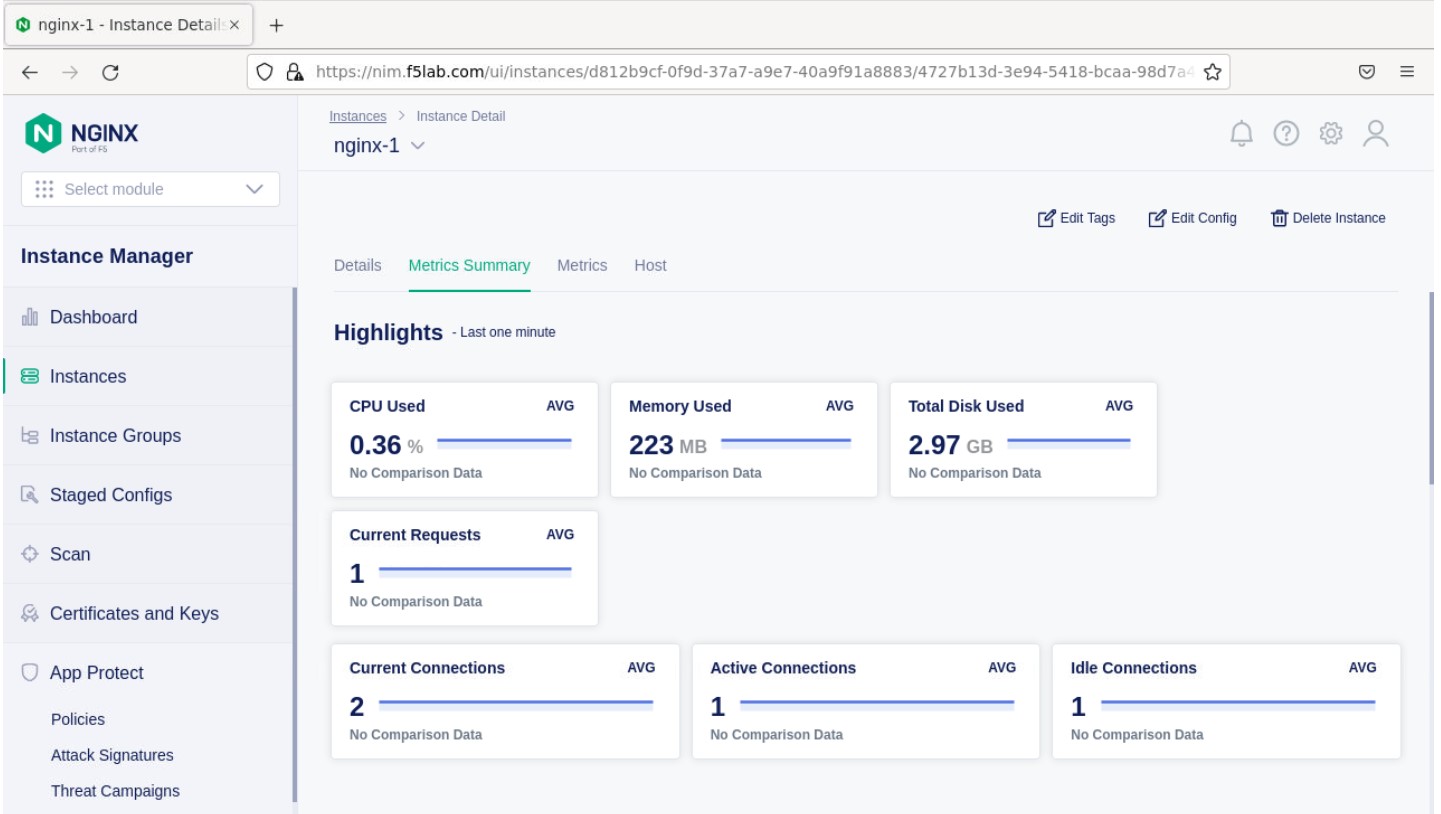
7. Now let’s refresh the Instance Manager page. We should see the instance under the ‘Instances’ tab.
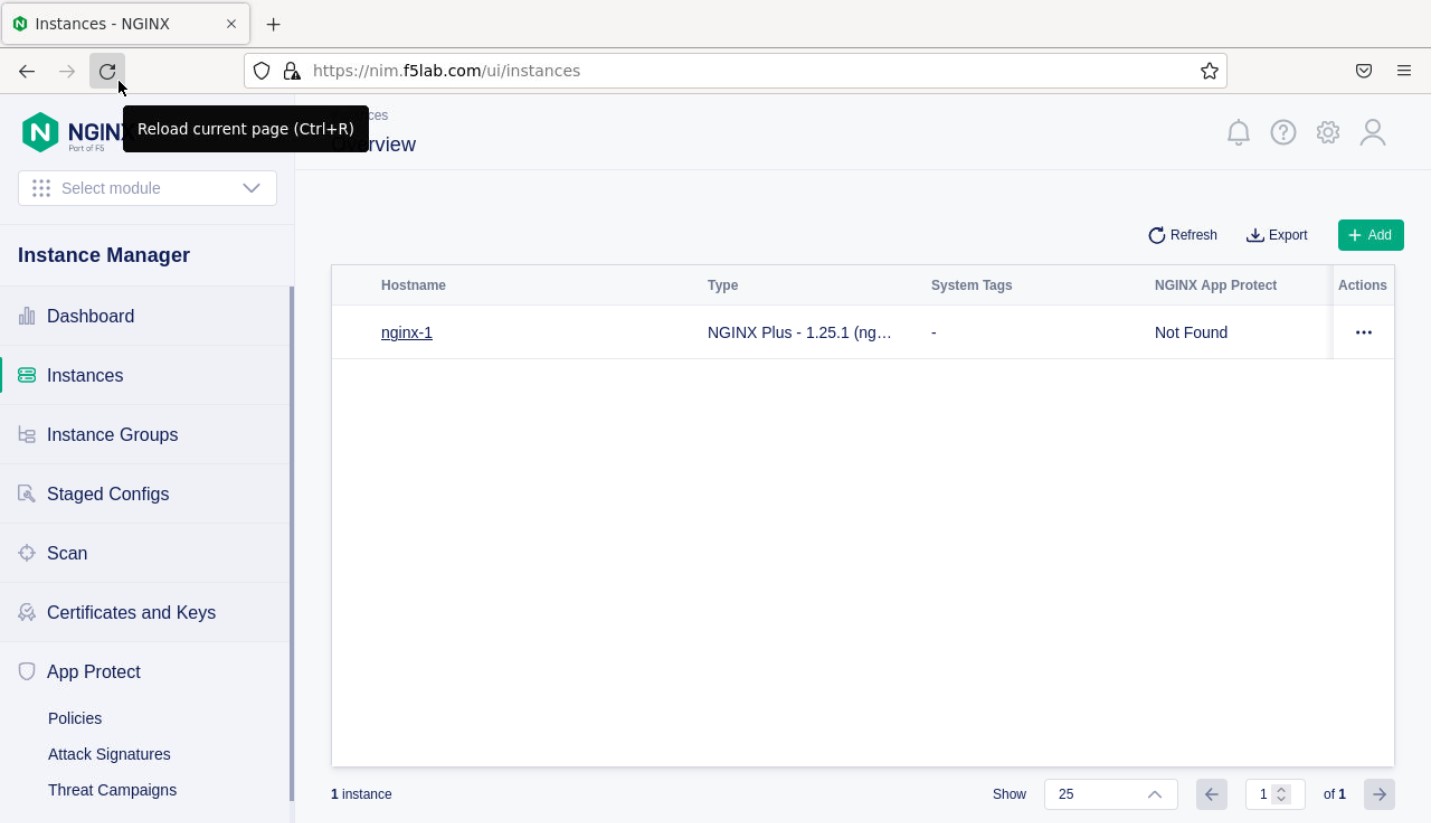
8. Clicking on the instance will show installation details and metrics (these may take a few minutes to correlate).
Create the Nginx Plus Cluster in Instance Manager
1. To begin, we need to install the same agent on the new NGINX servers. First open a webshell connection to NGINX 2 and then do the same for NGINX 3 (at this point, you should have all three NGINX servers open in UDF Webshell tabs).
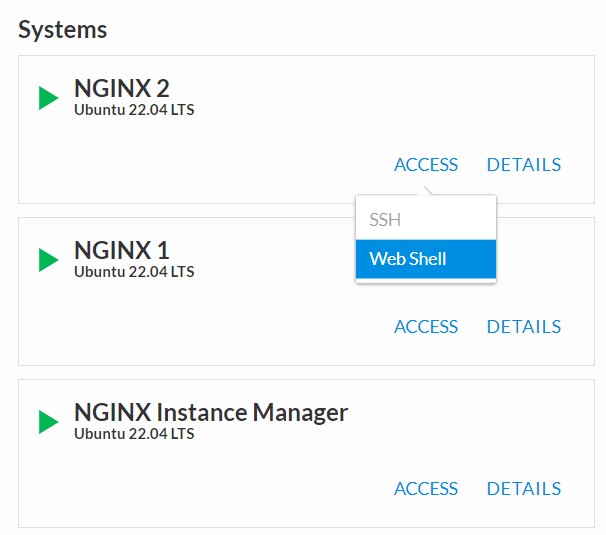
Copy and run the below command on -both- the NGINX 2 and NGINX 3 servers to install the agent.
curl -k -O https://nim.f5lab.com/install/nginx-agent
sudo sh nginx-agent --instance-group default
2. Once the installation is complete, start the nginx agent on -both- servers.
sudo systemctl start nginx-agent
Note
Please leave all of the NGINX server webshell connections open!
3. Go back to the Instances Overview in Instance Manager and you should see the new servers.
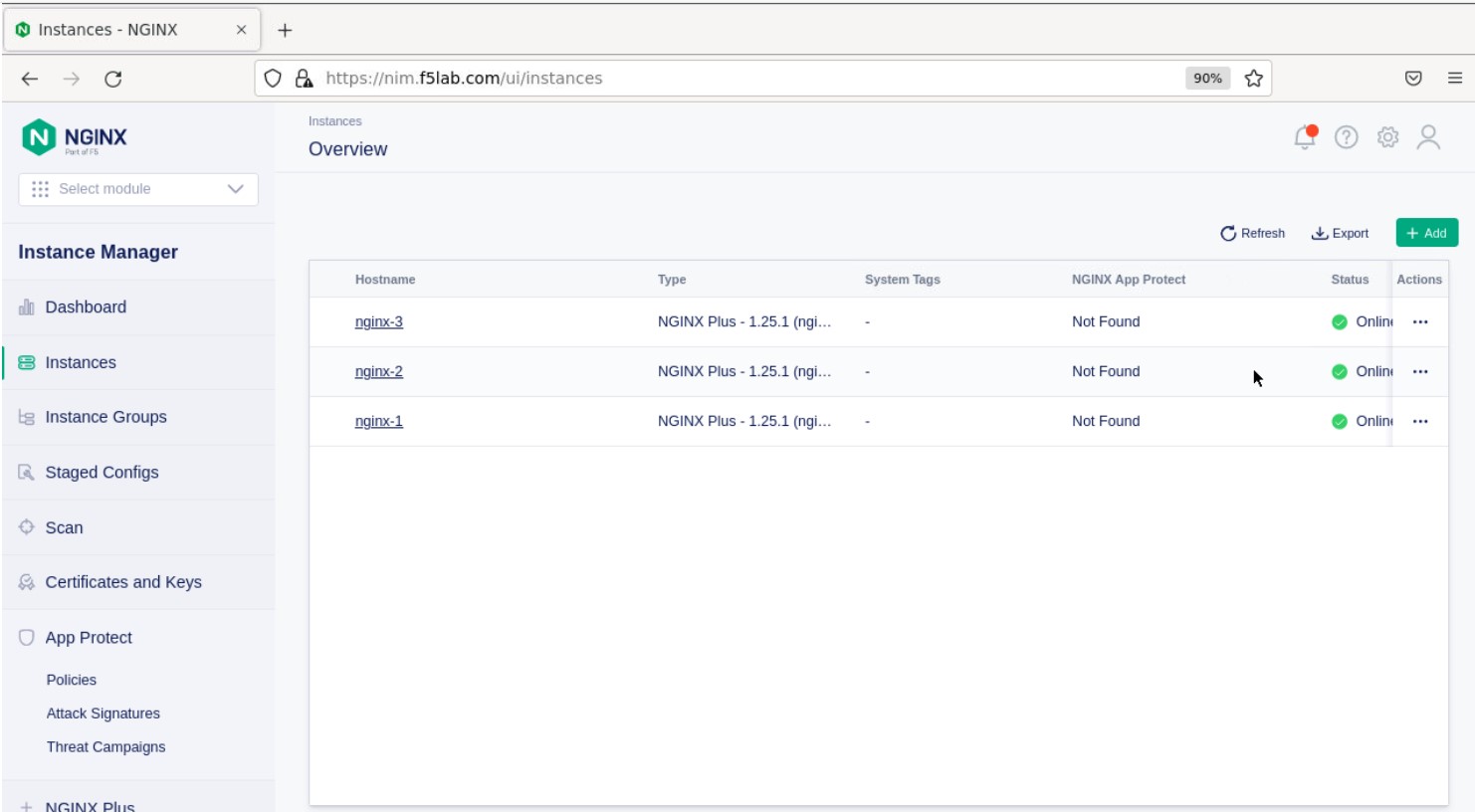
- Now you can click on ‘Instance Groups’ to see the Instance Group created.
In order to make sure our new cluster is performant, we need to sync the authentication tokens between the instances.
5. Open the default instance group and uncomment the stream block in the /etc/nginx/nginx.conf file to enable cluster state sharing and click publish.

save and close file
6. Now we will go back to UDF and select ‘Access’ –> ‘TMUI’ to log on to the BIG-IP (admin:f5r0x!) in order to test and validate the configuration.
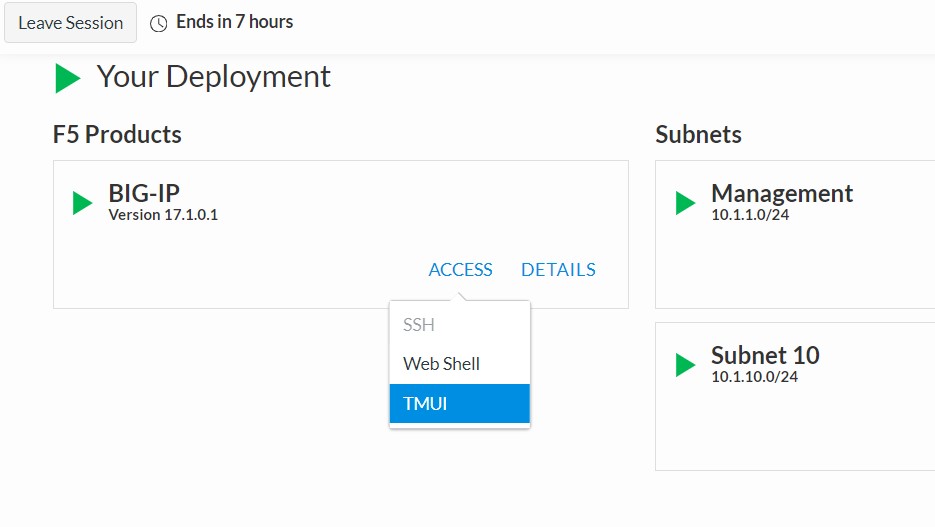
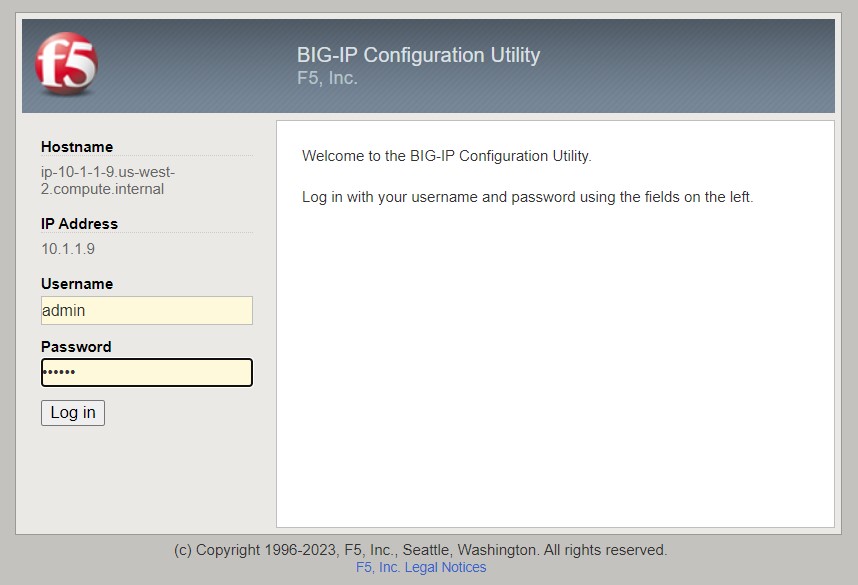
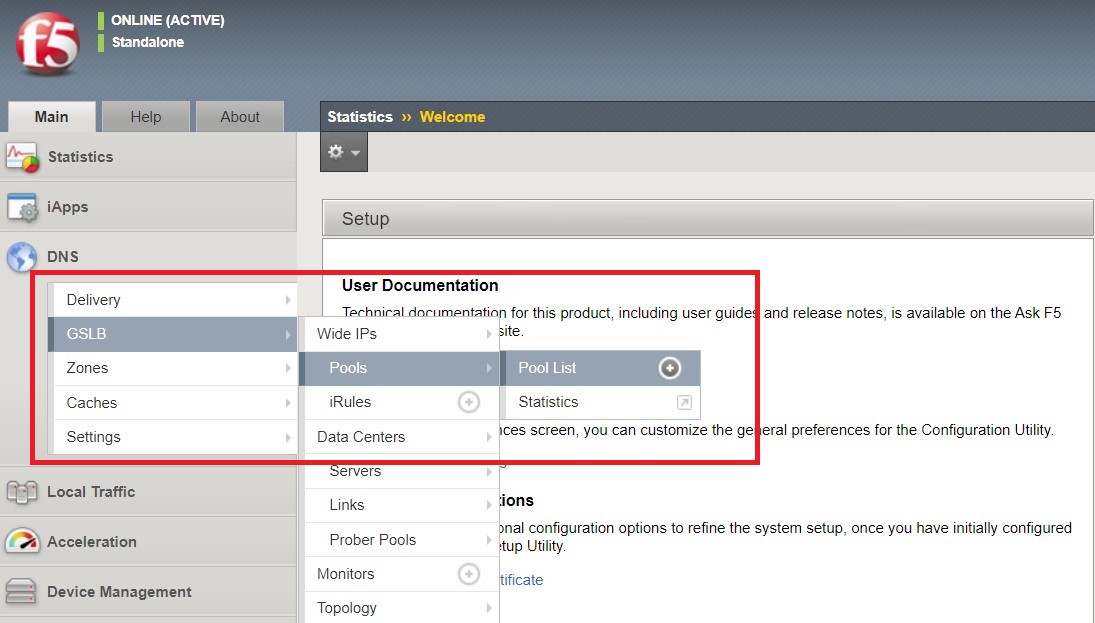
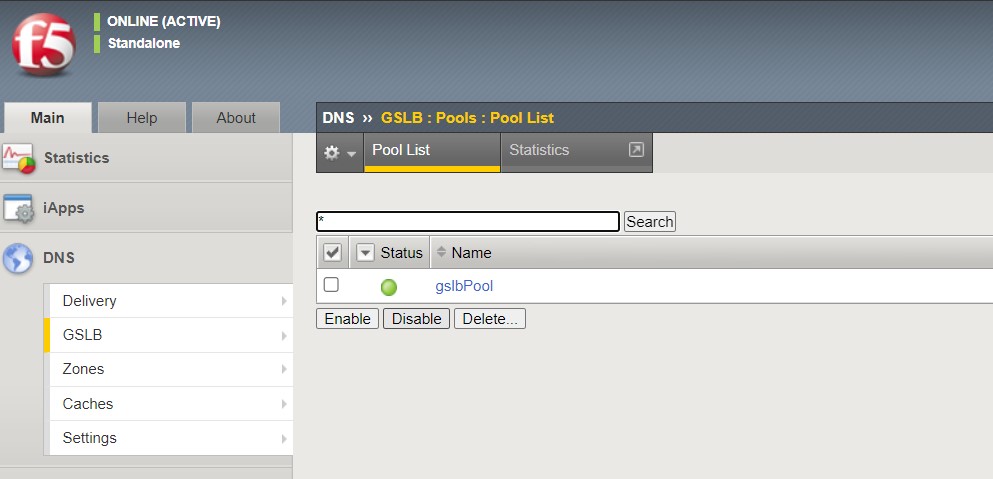
Navigate to DNS > GSLB > Pools > Pool List and select ‘gslbPool’.
8. Click the ‘Statistics’ tab and you’ll see all nginx instances are currently enabled where nginx-1 has ‘Preferred’ resolutions listed under ‘Load Balancing’.
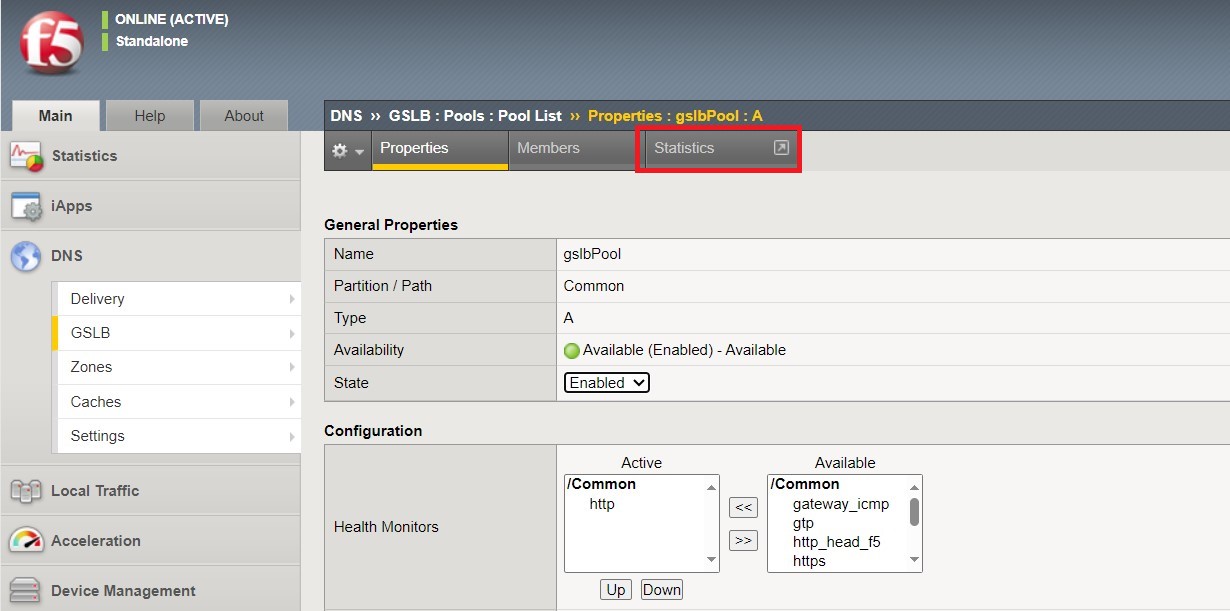
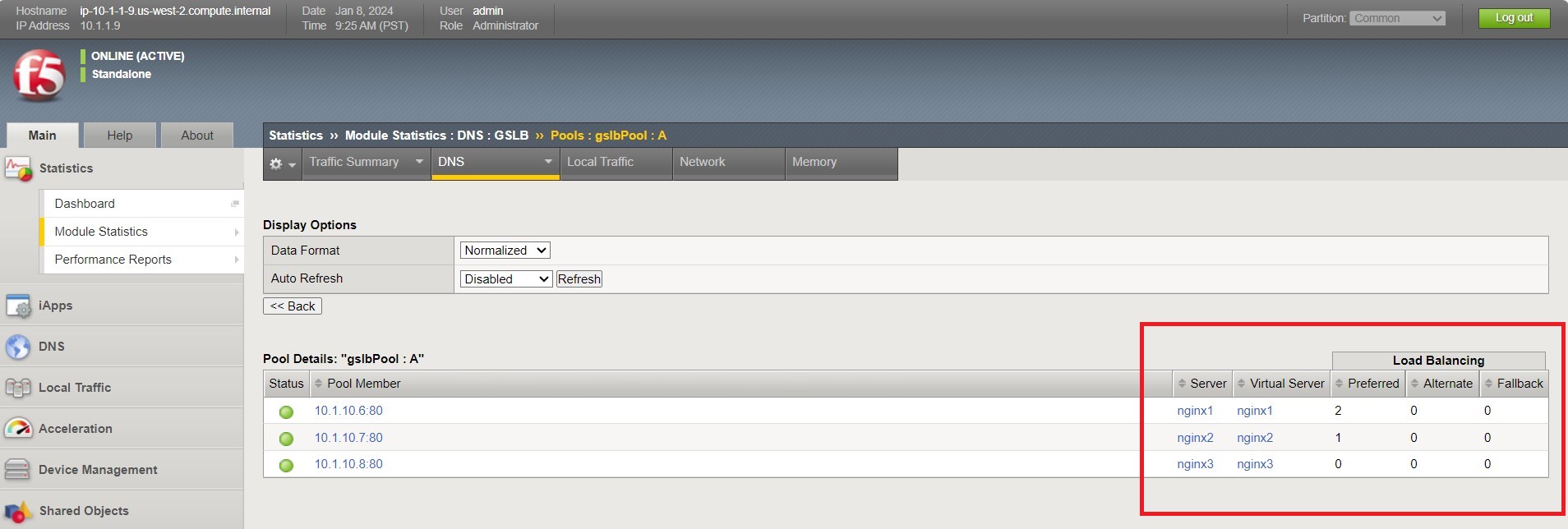
9. Click the ‘back’ button on your web browser to get back to the ‘gslbPool. This time select the ‘Members’ tab.
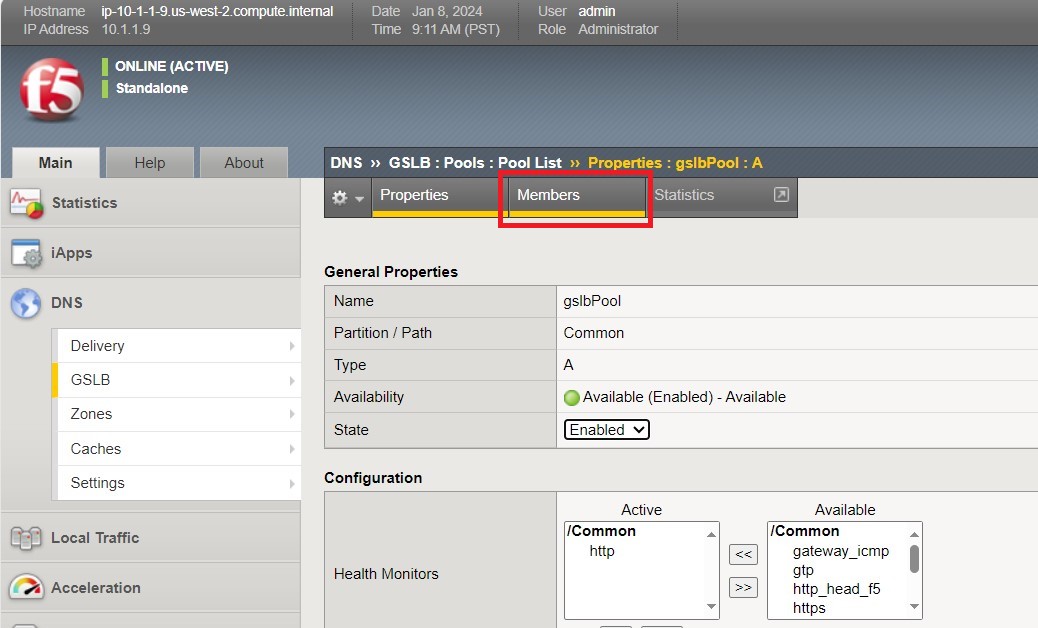
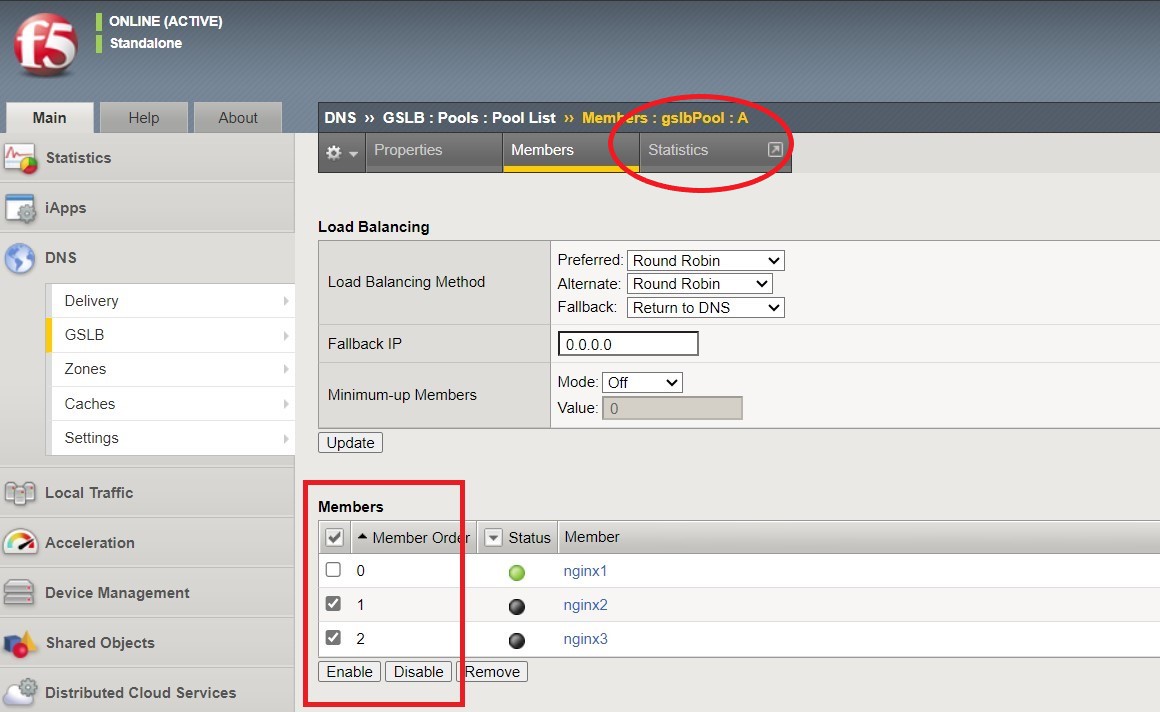
10. Here you can check boxes next to ‘nginx2’ and ‘nginx3’ and click ‘Enable’ or ‘Disable’ to add/remove them from the load balancing pool.
11. Go back to Firefox, open a new tab, and navigate to https://nginxdemo.f5lab.com:8010 again.
Log back in as user01 with password: appworld2025, as needed.
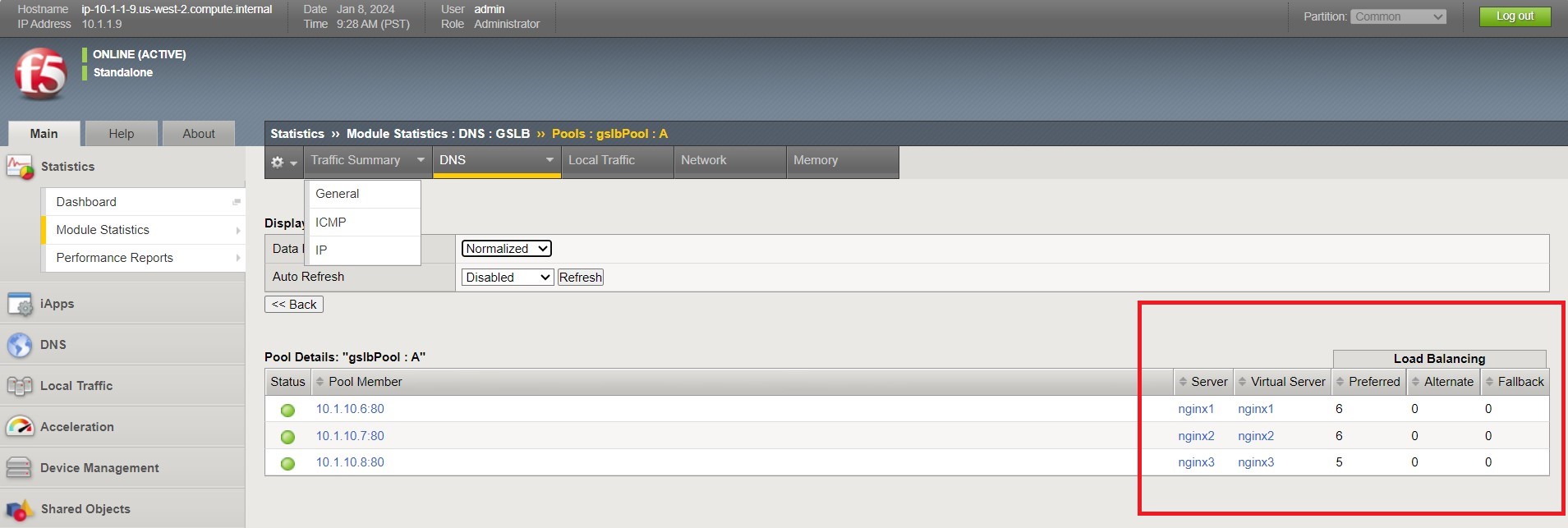
12. Go back to the BIG-IP and refresh the page (Ctrl-F5) to verify that the successful login was performed by one of the other NGINX servers, in this case, nginx2.
13. Refresh the page in Firefox several times (Ctrl-R) and then refresh the BIG-IP Statistics again (Ctrl-F5) to confirm that the load balancing is leveraging each of the NGINX servers.
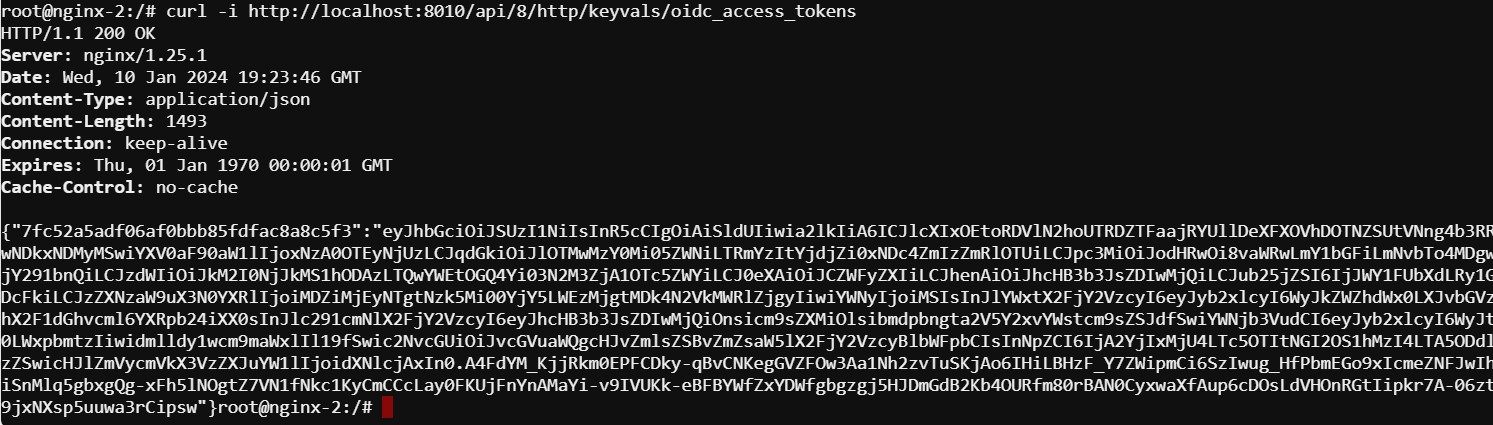
14. Finally, validate the configuration by running the command below on -each of the three- NGINX Plus servers to confirm that the access token has synchronized.
curl -i -k https://localhost:8010/api/8/http/keyvals/oidc_access_tokens
For example, below we see the access token on nginx-2. Run the same command on nginx-1 and nginx-3 and you should see the same token.
Congratulations, you have successfully completed the lab!