NGINX Modern Apps > Class 6 - NGINX API Management > Module 3 - Publish the API Source | Edit on
Step 6 - Publish API v3.0
The API Dev has now modified an existing endpoint. They modified the Locations micro-service in order to add a new JSON object for the coordinates of the location.
To do so, they:
- Created a new micro-service container image, with a new tag (v3.0): registry.gitlab.com/sentence-application/locations/volterra:v3.0
- Created a new version (v3.0) of the OAS spec file: https://app.swaggerhub.com/apis/F5EMEASSA/API-Sentence/3.0
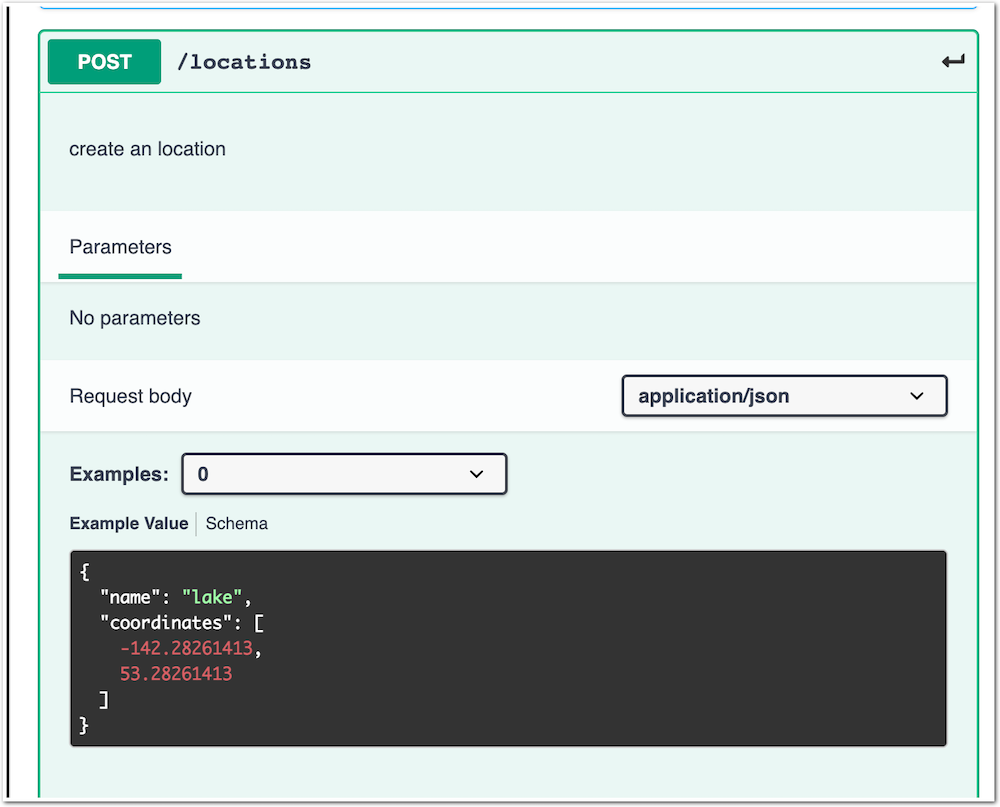
As you can see in the OAS file v3.0, the /locations endpoint has a new JSON object:
Warning
Modifying an existing API endpoint means the API v2.0 will break. Any mobile application or API client using the /locations endpoint will receive an error if we don’t create a dedicated version for this new API version.
Steps to publish API v3.0
Deploy the new Locations v3.0 micro-service in k8s
Let’s deploy the Locations v3.0 micro-service!
SSH (or Web) to the
Docker (k3s + Rancher + ELK)VM.Run the following
kubectlcommand in order to deploy theLocationsmicro-service and its k8s service:sudo su kubectl apply -f /home/ubuntu/k3s/attributs_locations_v3.yaml -n api
Note
As you can notice, this micro-service is deployed in the same
NameSpaceas the otherWordsmicro-services (api), and the previous version of theLocationsmicro-service is still there, because it’s currently used by clients.RDP to the
Win10VM (user/user).Check in
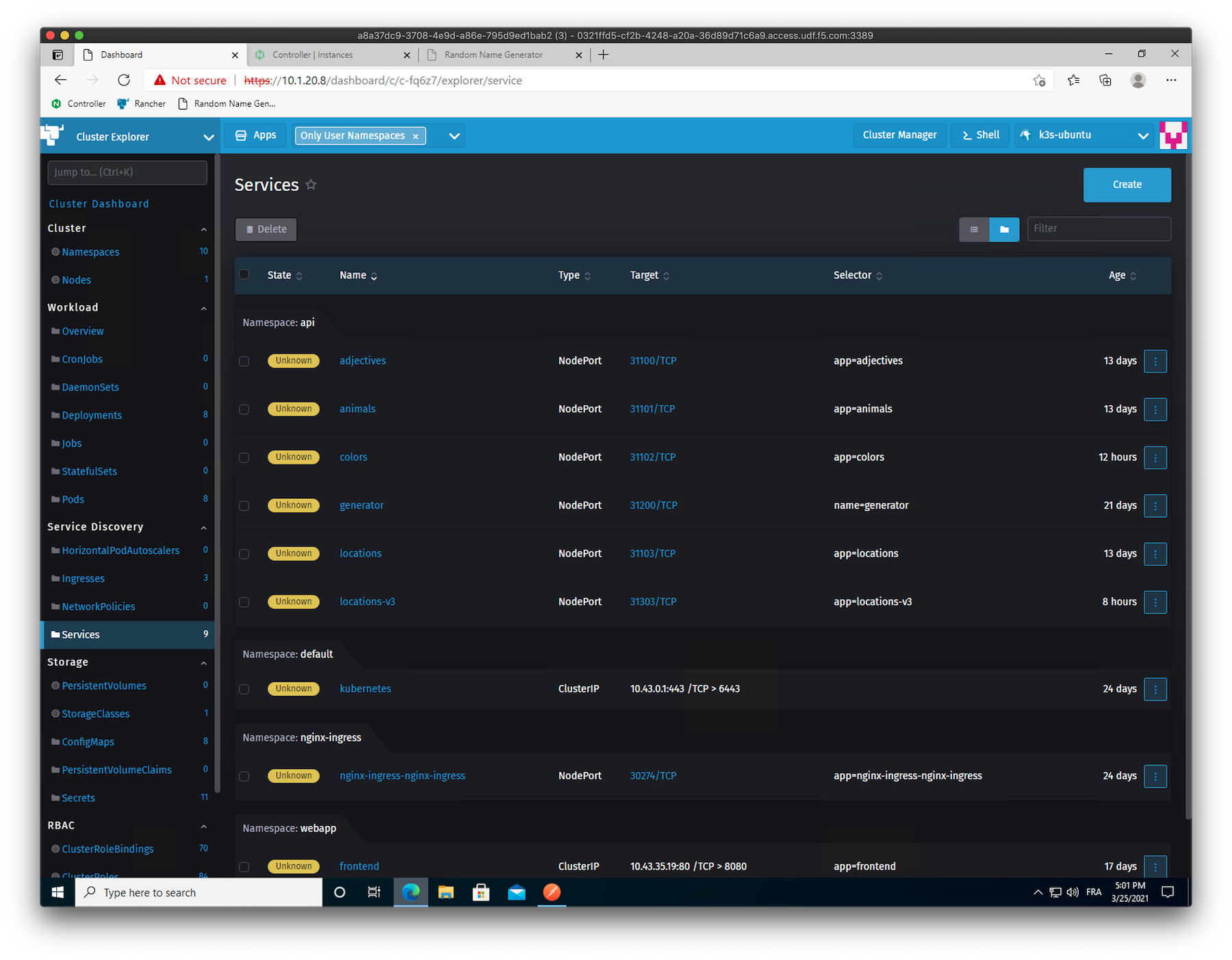
Rancher(admin/admin) that the newDeploymenthas been successful (both theDeploymentandService)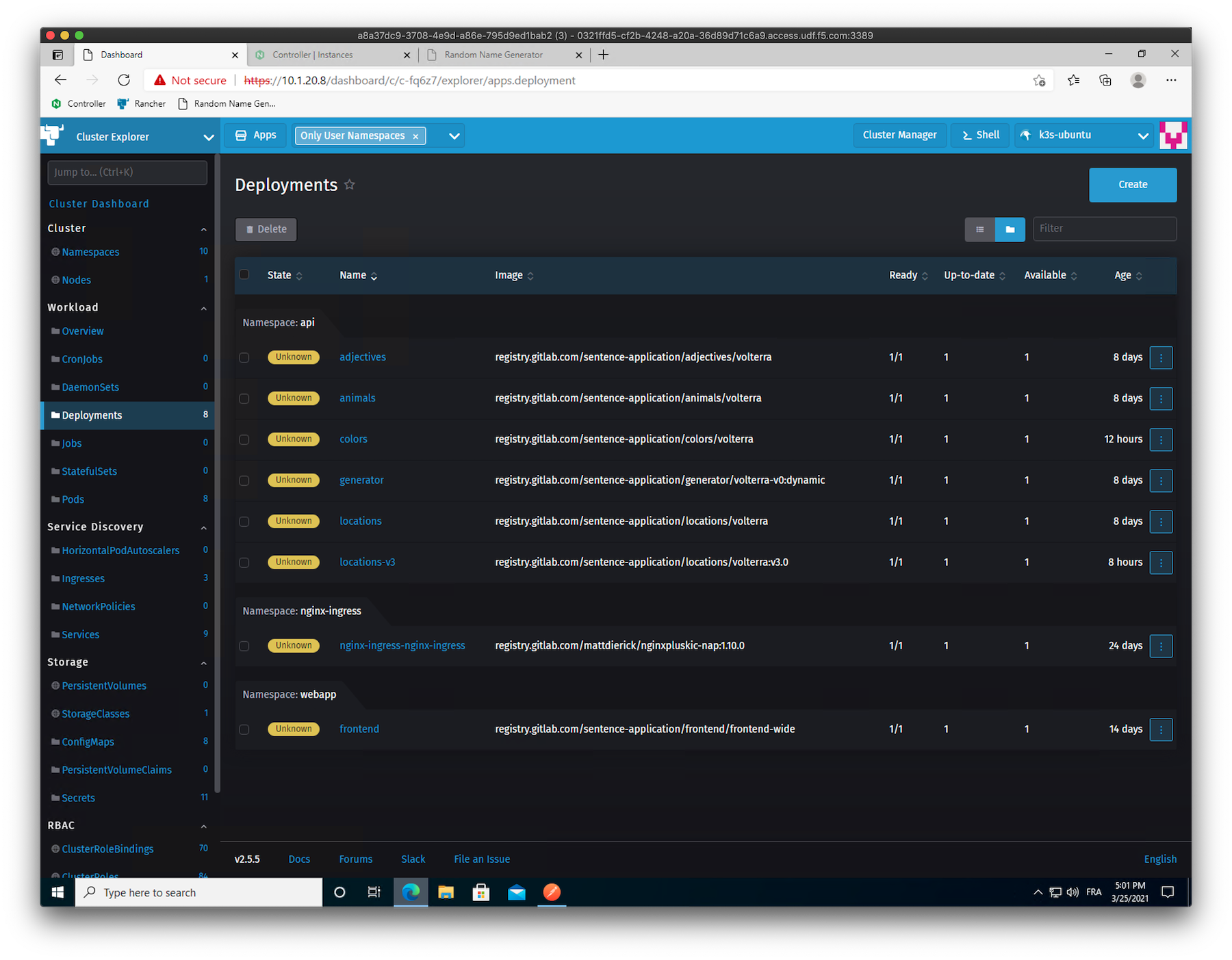
Note
Great! So now, the Location micro-service is running with 2 versions (v1.0) and (v3.0). Both versions are published through NodePort on 2 different ports:
- Port 31103 for Locations v1/v2
- Port 31303 for Locations v3
Create version 3.0 for the existing API Definition
Connect to NGINX Controller, and enter in the APIs configuration section (Top left Nginx Logo menu -> Services -> APIs)
Select your API Definition
api-sentence, and on the top right corner selectAdd Version.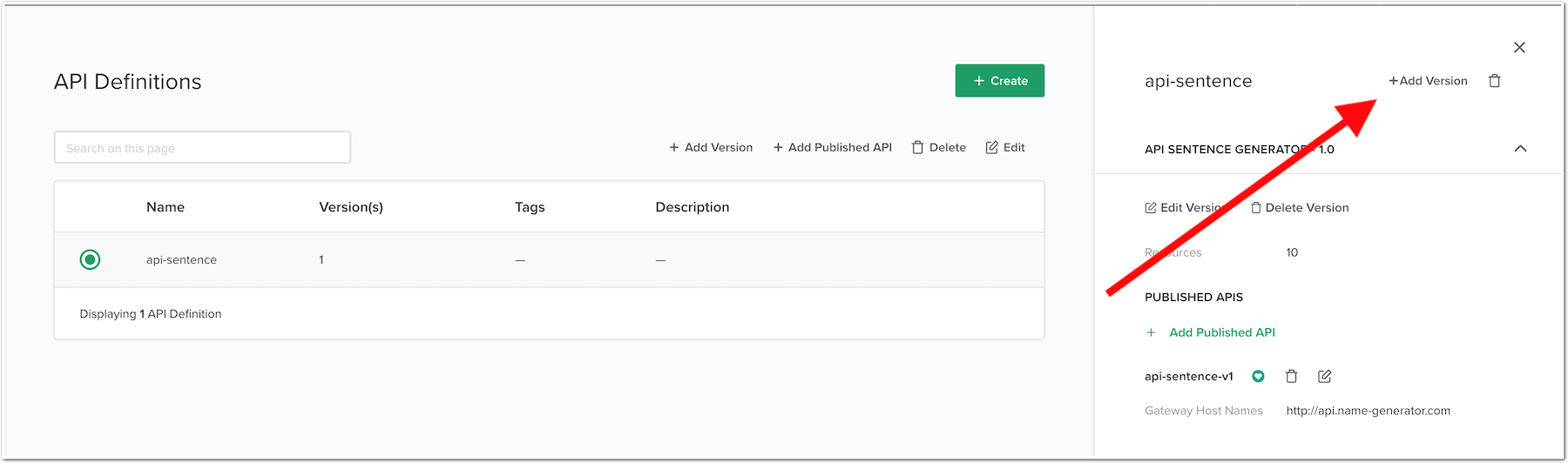
Select
OpenAPI Specification->Copy and paste specification text.Copy and paste the v3.0 OAS YAML content from https://app.swaggerhub.com/apis/F5EMEASSA/API-Sentence/3.0
Note
You can notice the version is automatically set to
3.0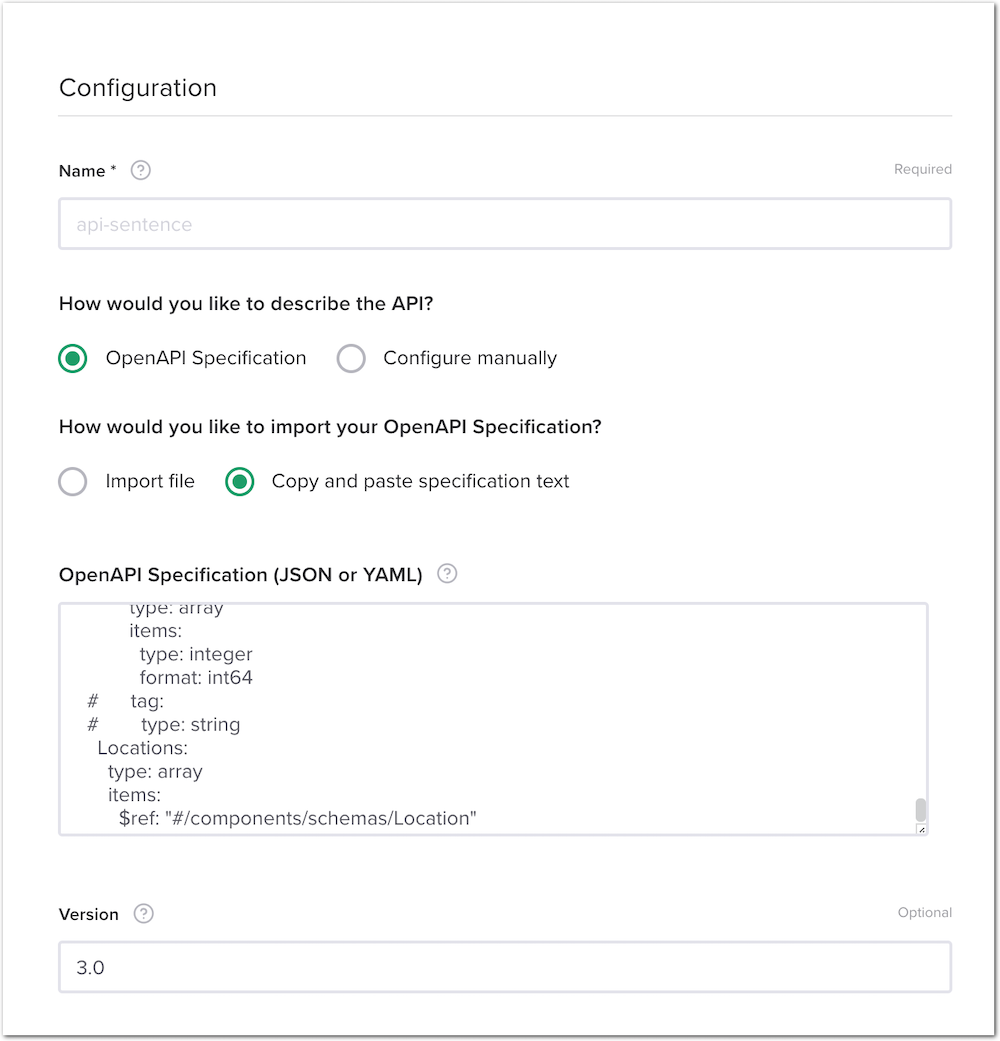
Click
Submit
Note
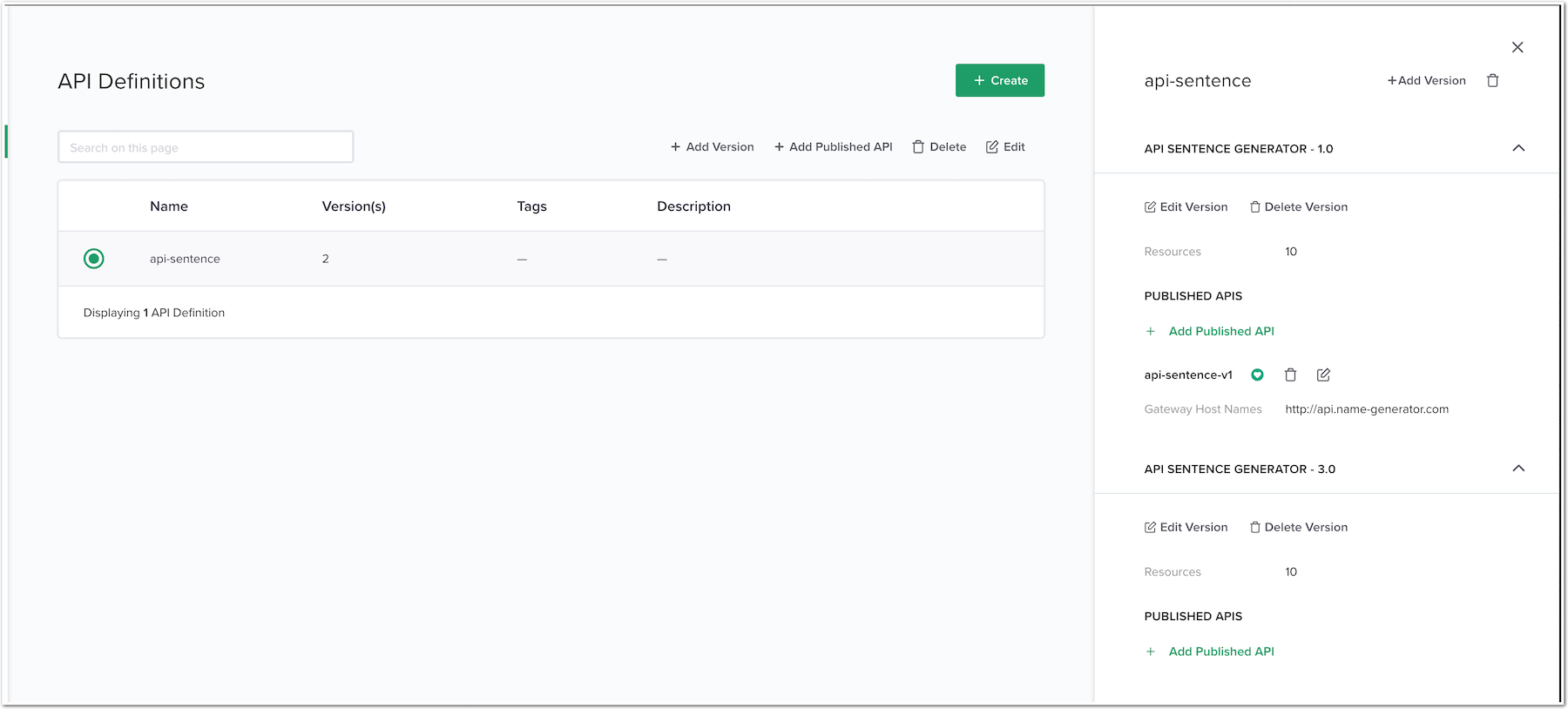
You should now see on the right sidebar the new 3.0 version
It is time to publish this new version of the API for a sample of clients (early access, beta …)
Publish version 3.0 of the API
Note
This new API version will listen on a specific path (/v3/) in order to differentiate the Production API (v2.0) from this Early Access API (v3.0).
Select the 3.0 API Definition, click on
Add Published API. Use the following values: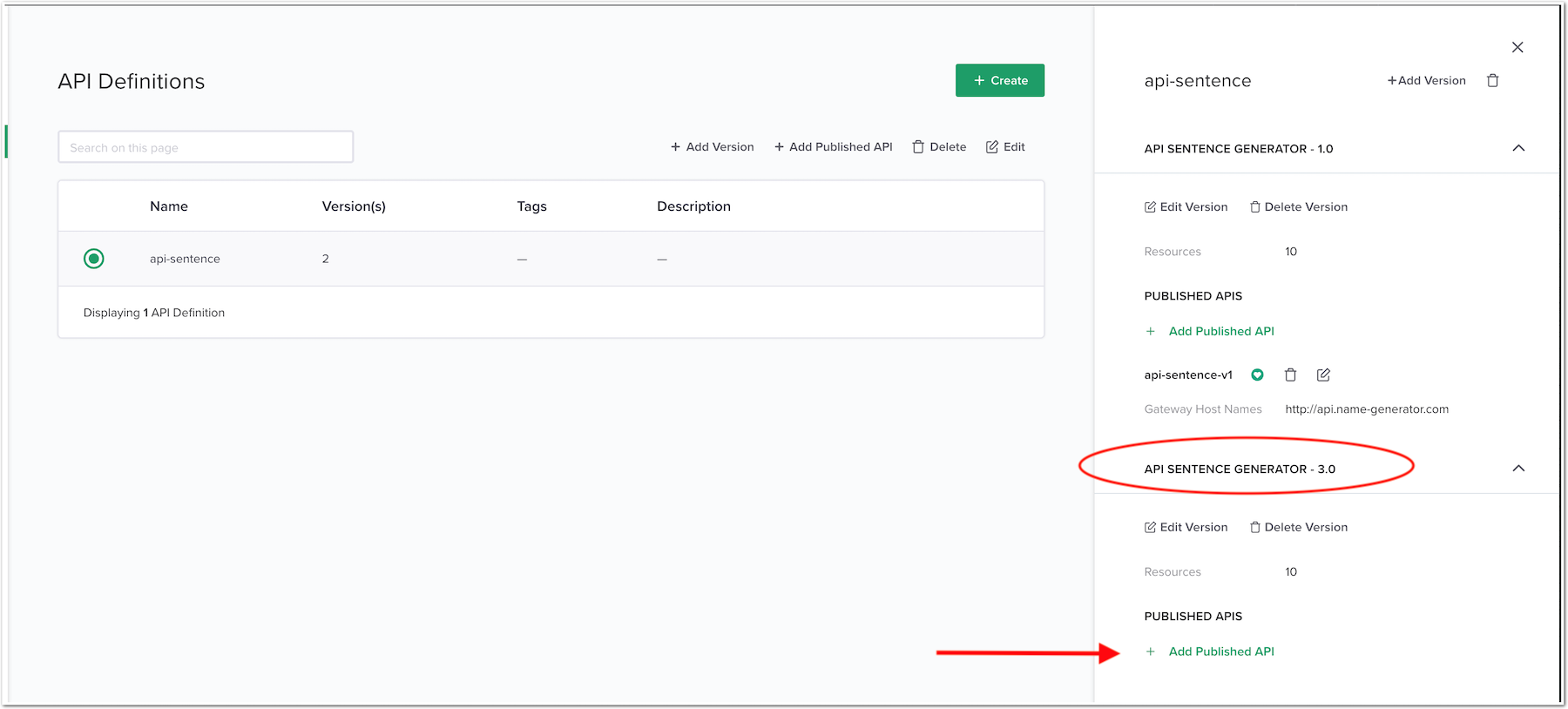
Start by setting the
Base Path. This is the path to differentiate the various Published APIs. Set it to/v3and check the boxStrip Base Pathso that the API Gateway does not use the path to connect to the backend micro-services.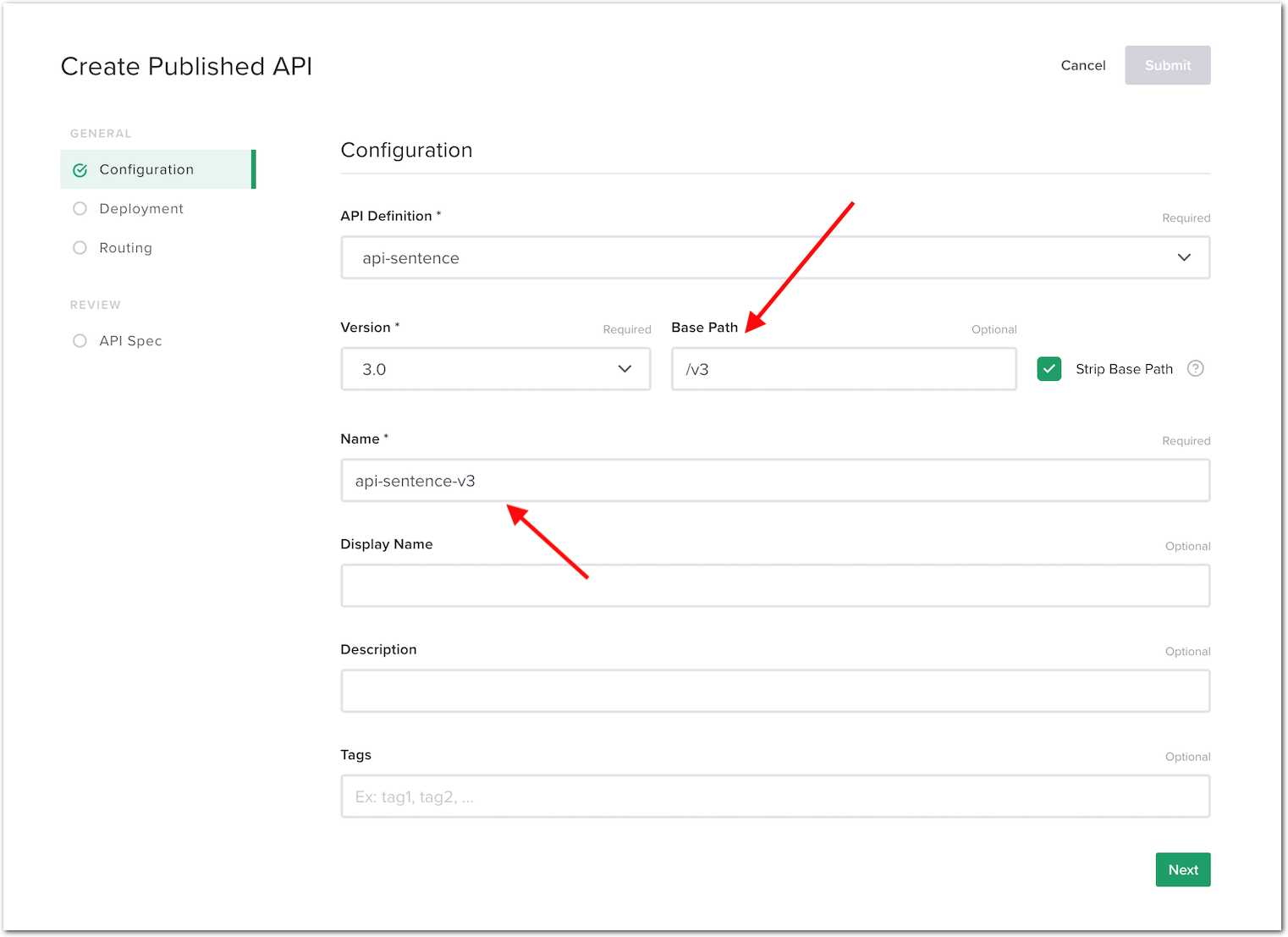
Name:
api-sentence-v3Click
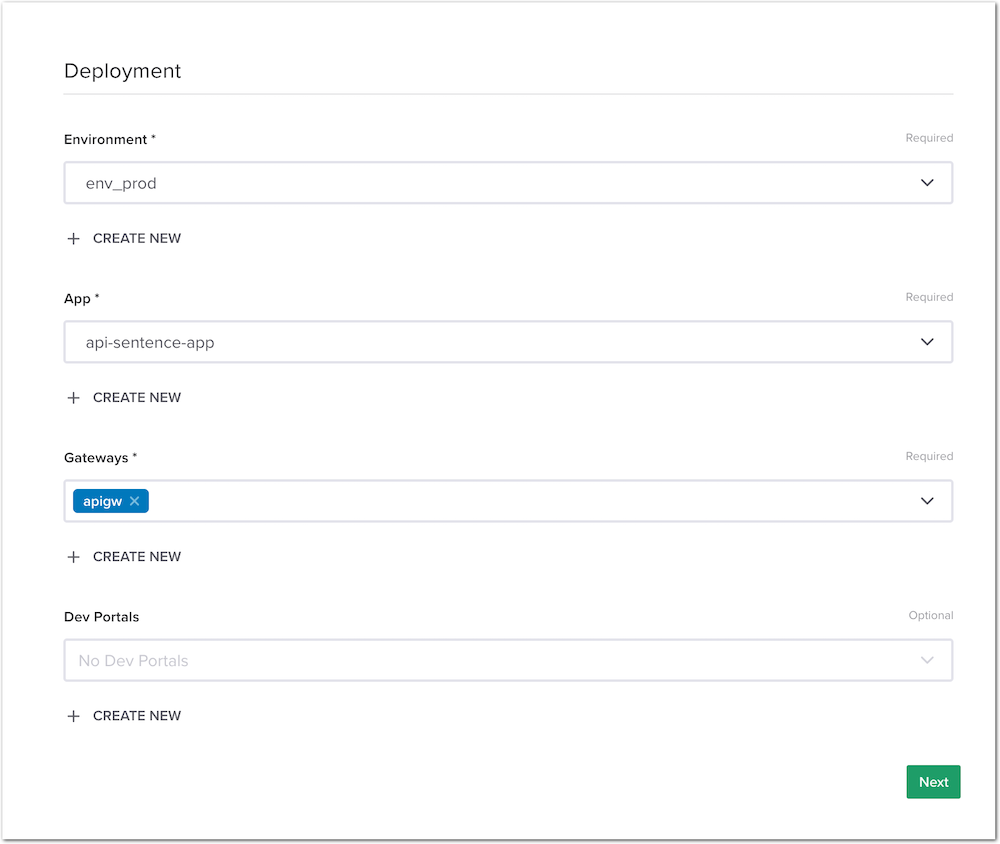
Next.Set the Environment, the App and the Gateway as with version 1.0.
Click
Next
Configure the
Routingas with version 1.0 except for thelocationcomponent which now routes the traffic to a different micro-service in k8s (listening on port 31303 instead of 31103 for v1.0).List of all micro-services and their component configuration.¶ Name Workload Group Name Backend Workload URI cp-generator-v3 wl-generator-v3 http://10.1.20.8:31200 cp-locations-v3 wl-locations-v3 http://10.1.20.8:31303 cp-animals-v3 wl-animals-v3 http://10.1.20.8:31101 cp-adjectives-v3 wl-adjectives-v3 http://10.1.20.8:31100 cp-colors-v3 wl-colors-v3 http://10.1.20.8:31102 Drag and drop each
Pathresource to thecorresponding component.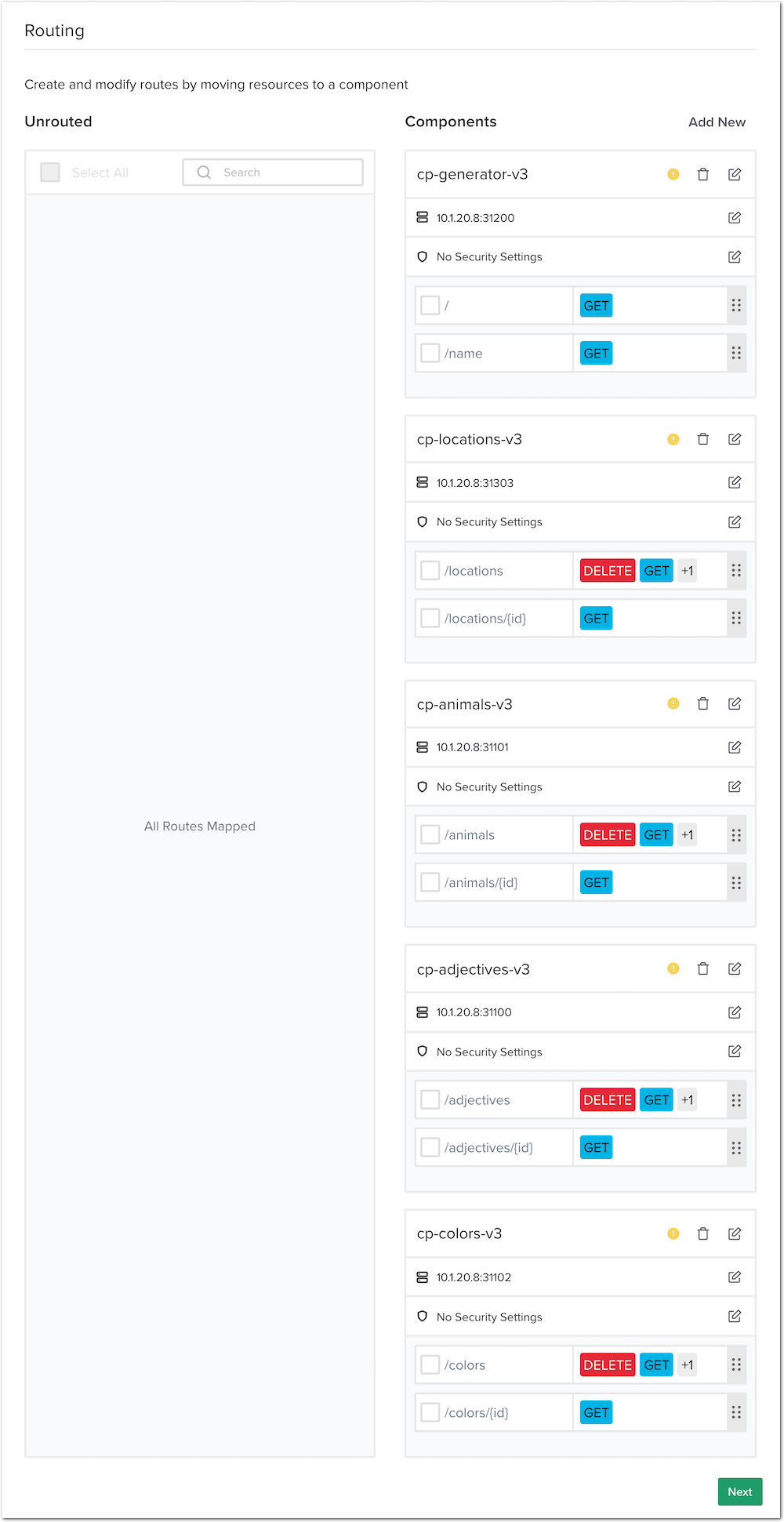
Click
SubmitCheck if your
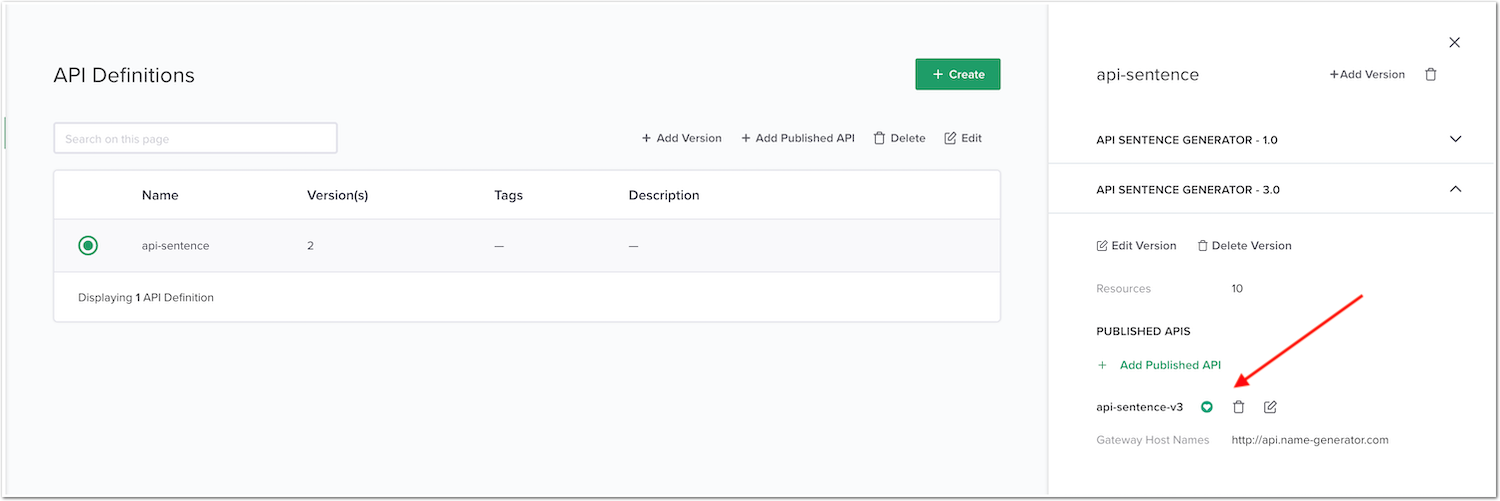
Published APIis green. If not, address any errors and re-submit.Note
The flag can take some time to become GREEN (due to resources limitations in UDF). If the flag is RED, wait few seconds, and re-submit your changes (refresh the page too).
Test the v3.0 (and v2.0) API deployments
Steps:
RDP to the
Win10VM (user/user).Open
Postmanand theAPI Sentence Generator v3collection.Send a request with the
GET Colors v3call, and check thePATH. Notice that thePATHstarts with/v3. It means the request is being routed by version 3 of the API Definition.[ { "id": 1, "name": "red" }, { "id": 2, "name": "blue" }, { "id": 3, "name": "green" }, { "name": "black", "id": 4 }, { "name": "yellow", "id": 5 } ]
Send a request with the
GET Locations v3call. This is the updated version of thelocationmicro-service running in k8s.[ { "id": 2, "name": "park", "coordinates": [ -142.28261413, 53.28261413 ] }, { "id": 3, "name": "mountain", "coordinates": [ -110.28261413, 31.28261413 ] }, { "name": "valley", "coordinates": [ -123.10664756, 49.28261413 ], "id": 4 } ]
Note
As you can see, we now have a new JSON object
coordinates, coming from the updatedlocationmicro-service.Send a request with the
GET Locationscall in theAPI Sentence Generator v1 and v2collection in order to test that version 2.0 is still up and running.[ { "id": 1, "name": "valley" }, { "id": 2, "name": "park" }, { "id": 3, "name": "mountain" } ]
Warning
Congrats! You published v3.0 of your API and it’s correctly being routed to the new locations micro-service! Furthermore, version 2.0 is still available for any “current” clients. Only the Early Access clients querying the /v3 path get access to this new API.