Overview of network infrastructure CRDs
Introduction
F5 BIG-IP Next for Kubernetes (BNK) allows you to manage network infrastructure using a set of Custom Resource Definitions (CRDs).
The CRDs align with the Kubernetes Gateway API model, introduce role-based access for different infrastructure personas, and simplify the configuration experience by consolidating multiple resources into fewer, more intuitive definitions.
Important
If you adopt the Gateway API model, you must define your network infrastructure using the new CRDs.
The three new CRDs:
CRD |
What it does |
|---|---|
Infra |
Centralizes underlay network configuration, including IP Address Management (IPAM) pools, VLANs, VXLANs, Virtual Routing and Forwarding (VRF) definitions, and static routes |
GatewaySettings |
Configures tenant-specific traffic settings, including Source NAT (SNAT) pools and ingress and egress behavior |
EgressGateway |
Defines how application pods send outbound traffic through a specific egress gateway, with support for multi-tenancy and namespace selection |
In addition, SecPolicy now supports targeting the EgressGateway CRD, which applies firewall policies to egress traffic.
The Custom Resource (CR) status fields in all three CRDs follow the structure of Gateway API CRDs and provide more descriptive feedback than the legacy resources.
How the CRDs work together
The three CRDs form a layered configuration model. Each CRD serves a distinct role and references the one above it. This diagram shows the resource relationship from infrastructure, through GatewaySettings, to the Gateway or EgressGateway.
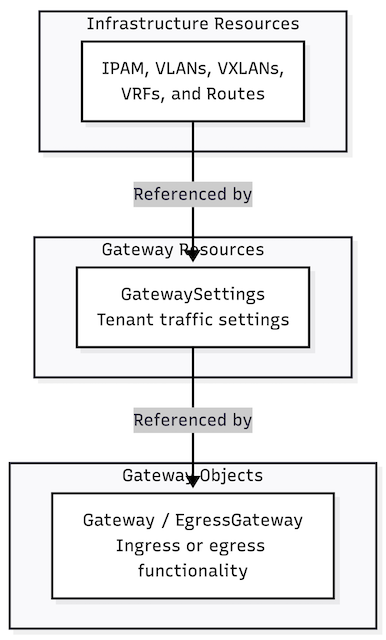
Typical deployment flow
Follow these steps, in order, to deploy network infrastructure with the new CRDs:
Install the product: Deploy the BNKGatewayClass (CNEInstance) to bring up the CNE controller and TMM with the appropriate network attachments.
Install GatewayClass: Create a GatewayClass resource to tell the CNE controller which Gateways it manages.
Deploy the Infra CR: Configure VLANs, VXLANs, static routes, IPAM pools, and VRFs for the default and any additional routing domains.
Deploy GatewaySettings (optional): Configure tenant-specific settings such as SNAT pools, ingress listener networks, and egress paths. This step is required only if you need tenant isolation or custom traffic settings.
Deploy Gateway or EgressGateway: Enable ingress or egress functionality. If you created a GatewaySettings CR, reference it in the Gateway or EgressGateway using the
infrastructure.parametersReffield.
Reconciliation
When you apply or update an Infra CR, the controller sends the updated configuration to TMM and cascades a reconcile to any GatewaySettings resources that reference it. GatewaySettings then cascades to the associated Gateway or EgressGateway resources. This chain ensures that changes to the underlay network propagate through to the traffic-handling layer without requiring you to manually update each resource.
When you update the Infra CR, only the changed configuration is sent to TMM. The controller does not treat updates as a full redeployment.
Persona-based deployment model
The new CRDs separate network configuration responsibilities by persona. This separation ensures that infrastructure concerns are managed independently from tenant-specific and application-level settings.
Persona |
Responsibility |
CRD |
|---|---|---|
Infrastructure provider / network operator |
Defines the underlay network: IPAM pools, VLANs, VXLANs, VRFs, static routes, and network attachments |
Infra |
Cluster operator / tenant network administrator |
Configures tenant-specific traffic settings: SNAT pools, ingress listener networks, and egress paths |
GatewaySettings |
Application developer / tenant administrator |
Deploys Gateways and EgressGateways to enable ingress and egress for application workloads; deploys HTTPRoutes and other route resources |
Gateway, EgressGateway |
CRD details
Infra
The Infra CRD defines the underlay network settings for your BNK installation. It is a single resource that consolidates what previously required multiple CRDs and a ConfigMap.
Scope: Must be deployed in the BNK namespace
API version:
gateway.k8s.f5.com/v1alpha1Kind:
InfraShort name:
infra
The Infra CR includes the following configuration sections:
Section |
Description |
|---|---|
|
Manages IP address allocation pools for VLANs, SNAT pools, and Gateway listener addresses |
|
References Kubernetes NetworkAttachmentDefinition resources used by networks |
|
Defines Virtual Routing and Forwarding (VRF) instances for network isolation |
|
Configures VLAN and VXLAN network definitions |
|
Defines static routes for specific destination prefixes |
The Infra CR also provides the default network configuration for any Gateway that does not explicitly reference a GatewaySettings resource.
Note
Infra is a singleton CR. Only one Infra CR can be deployed in the BNK namespace. Deploying multiple Infra CRs is not supported.
For the complete field reference, see /docs/custom-resource-definitions/bnk-infra.md.
GatewaySettings
The GatewaySettings CRD configures tenant-specific network and traffic settings. It references infrastructure elements defined in the Infra CR, such as IPAM pools and networks, to enable modular and reusable network design.
Scope: Must be deployed in the same namespace as the Gateway or EgressGateway that references it
API version:
gateway.k8s.f5.com/v1alpha1Kind:
GatewaySettingsShort name:
gws
The GatewaySettings CR includes the following configuration sections:
Section |
Description |
|---|---|
|
Defines SNAT pools for ingress and egress traffic, referencing IPAM pools from the Infra CR |
|
Specifies the network and IPAM pools for handling incoming traffic, including listener address allocation and SNAT mode |
|
Specifies one or more named egress configurations, each with a network reference, SNAT settings, and optional hardware acceleration |
You can deploy GatewaySettings in three modes:
Ingress only — configure only
ingressConfigEgress only — configure only
egressConfigsCombined — configure both for a single tenant that handles ingress and egress traffic
For the complete field reference, see /docs/custom-resource-definitions/bnk-GatewaySettings.md.
EgressGateway
The EgressGateway CRD enables you to define how application pods in selected namespaces send outbound traffic through TMM.
Scope: Can be deployed in any namespace. The referenced GatewaySettings must be in the same namespace.
API version:
gateway.k8s.f5.com/v1alpha1Kind:
EgressGatewayShort name:
egw
Key features of the EgressGateway CRD:
Source selection modes: Choose how to select which pods use the egress gateway:
NamespaceSelector— all pods in matched namespacesPodSelector— specific pods matched by labelCombined— pods that satisfy both namespace and pod selection criteria
Infrastructure reference: Uses the
infrastructure.parametersReffield to reference a specificegressConfigssection in a GatewaySettings CRVLAN and VXLAN support: Supports egress through both VLAN and VXLAN encapsulation
Firewall policy support: SecPolicy can target the EgressGateway to apply firewall policies to egress virtual servers
Note
Like the legacy F5SPKEgress, the EgressGateway CRD does not create services, pools, or monitors.
For the complete field reference, see /docs/custom-resource-definitions/bnk-EgressGateway.md.