F5 Solutions for Containers > Class 1: Kubernetes with F5 Container Ingress Service > Module 1: CIS Using NodePort Mode Source | Edit on
Lab 1.1 - Install & Configure CIS in NodePort Mode
The BIG-IP Controller for Kubernetes installs as a Deployment object
See also
The official CIS documentation is here: Install the BIG-IP Controller: Kubernetes
In this lab we’ll use NodePort mode to deploy an application to the BIG-IP.
See also
For more information see BIG-IP Deployment Options
BIG-IP Setup
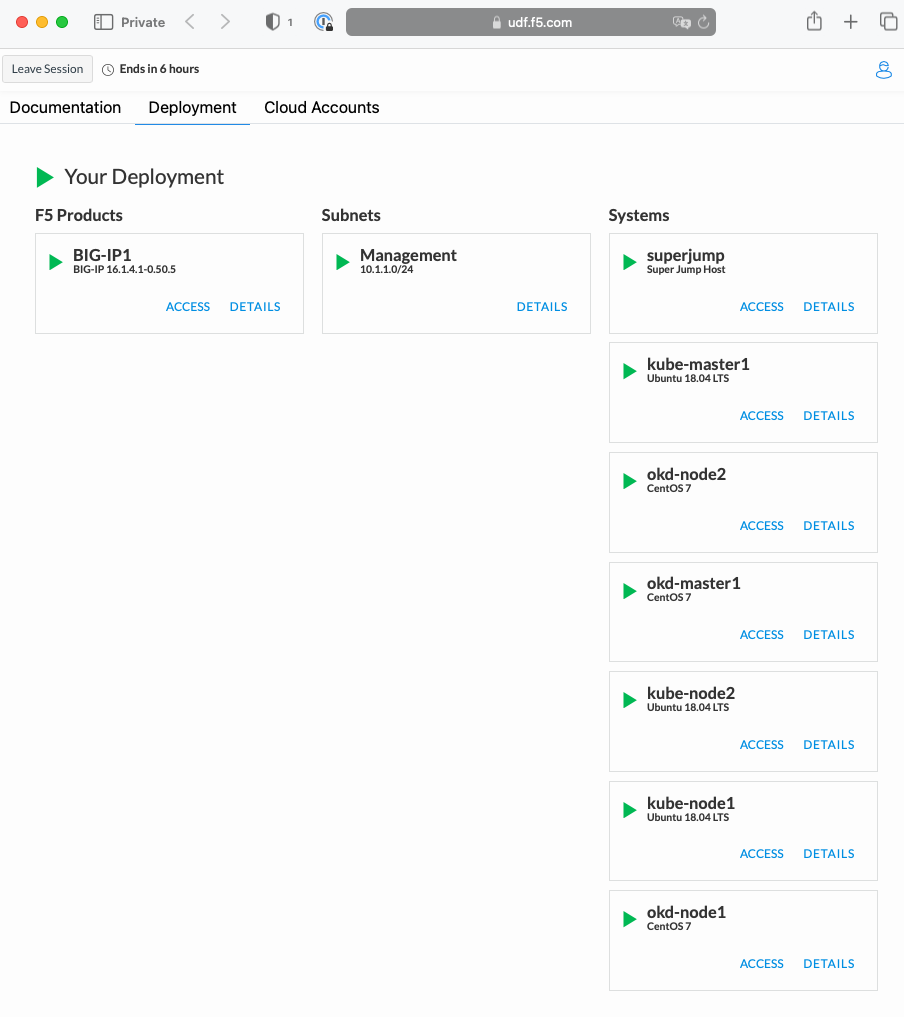
Browse to the Deployment tab of your UDF lab session at https://udf.f5.com and connect to BIG-IP1 using the TMUI access method.
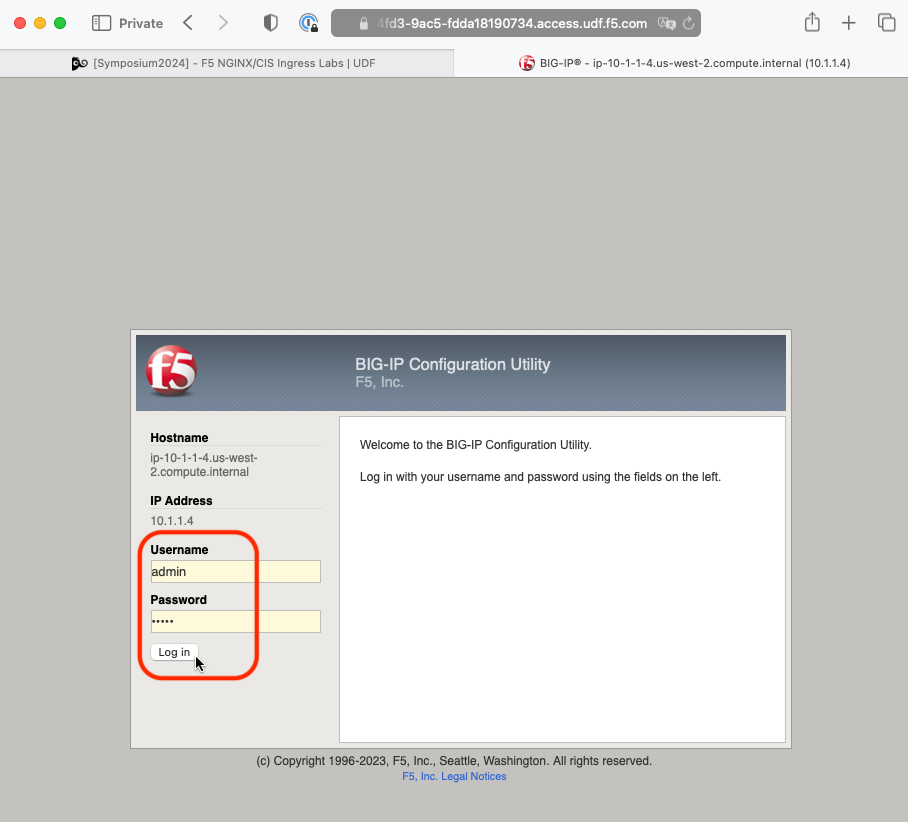
Login with username: admin and password: F5site02@.
Attention
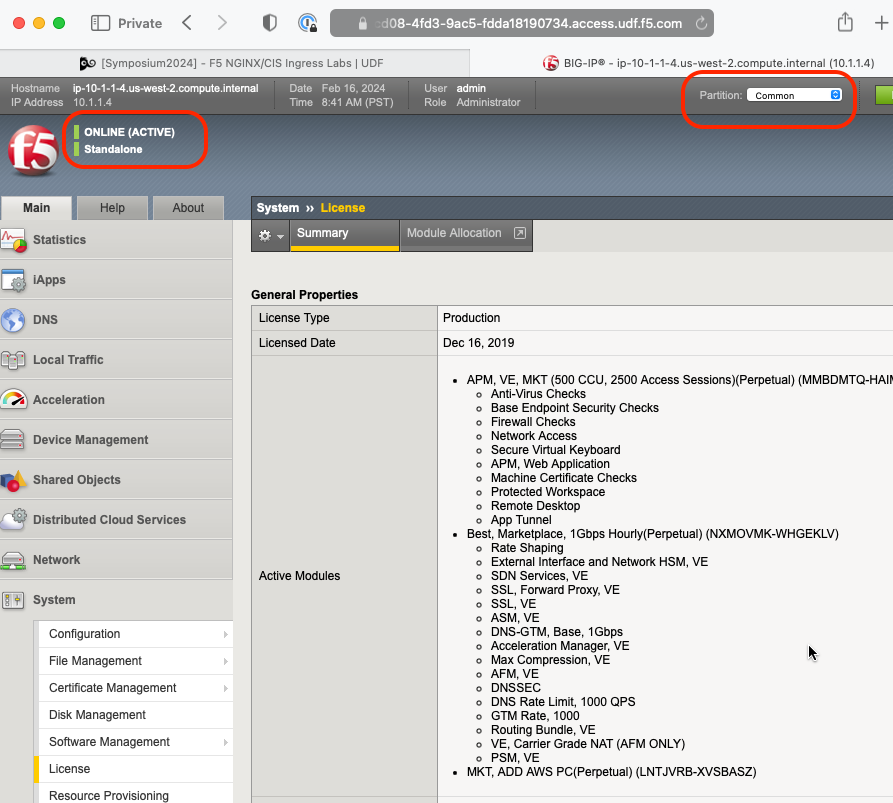
- Check BIG-IP is active and licensed.
- If your BIG-IP has no license or its license expired, renew the license. You just need a LTM VE license for this lab. No specific add-ons are required (ask a lab instructor for eval licenses if your license has expired)
- Be sure to be in the
Commonpartition before creating the following objects.

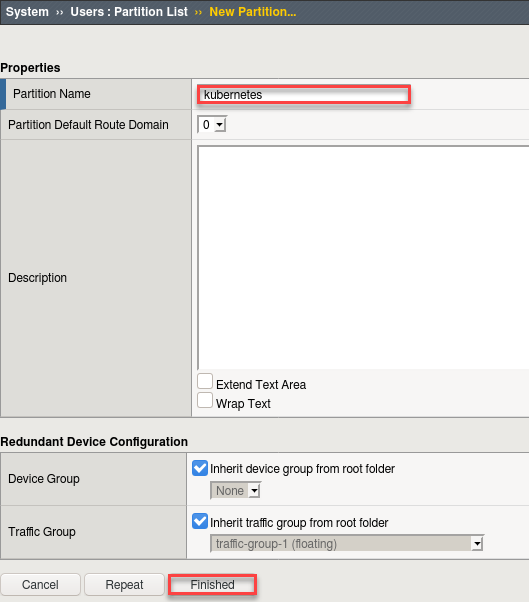
Create a partition, which is requiredfor F5 Container Ingress Service.
Browse to:
Attention
- Be sure to be in the
Commonpartition before creating the following
objects.
- Be sure to be in the
Create a new partition called “kubernetes” (use default settings)
Click Finished
# Via the CLI:
tmsh create auth partition kubernetes
Verify AS3 is installed.
Attention
This has been done to save time but is documented here for reference.
See also
For more info click here: Application Services 3 Extension Documentation
Browse to: and confirm “f5-appsvcs” is in the list as shown below.
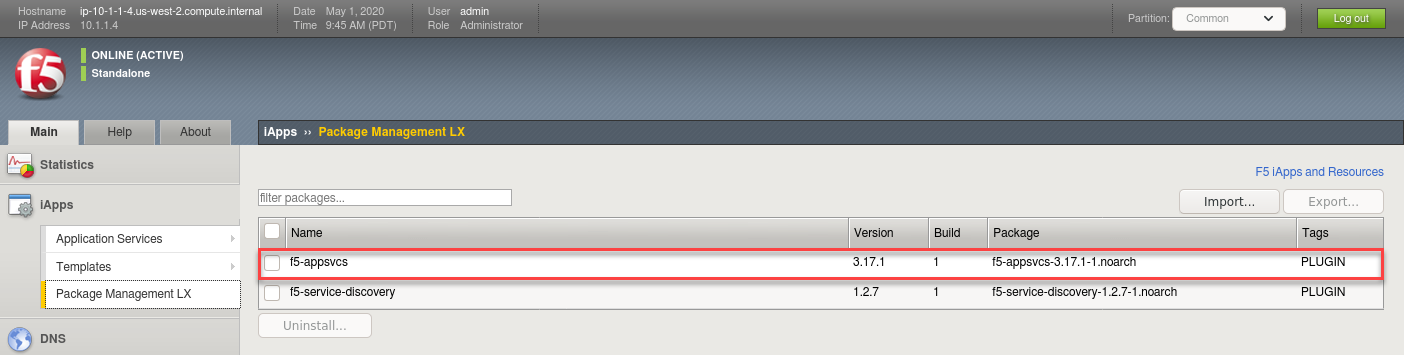
If AS3 is NOT installed follow these steps:
- Click here to: Download latest AS3
- Browse back to:
- Click Import
- Browse and select downloaded AS3 RPM
- Click Upload
Explore the Kubernetes Cluster
Go back to the Deployment tab of your UDF lab session at https://udf.f5.com and connect to kube-master1 using the Web Shell access method.
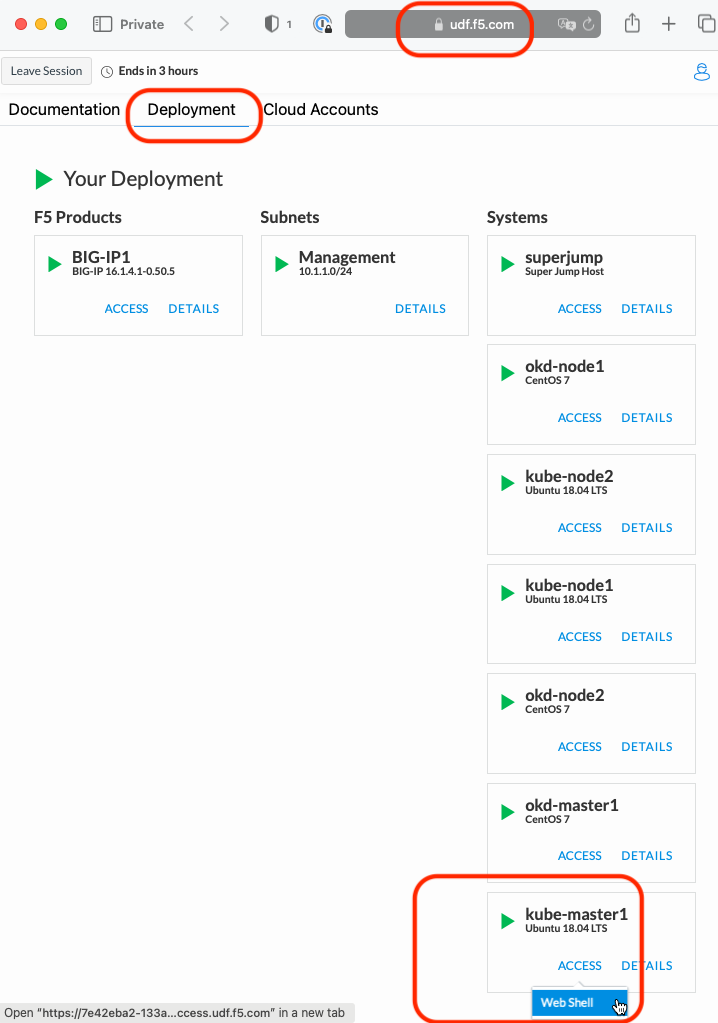
The CLI will appear in a new window or tab. Switch to the ubuntu user account using the following “su” command.
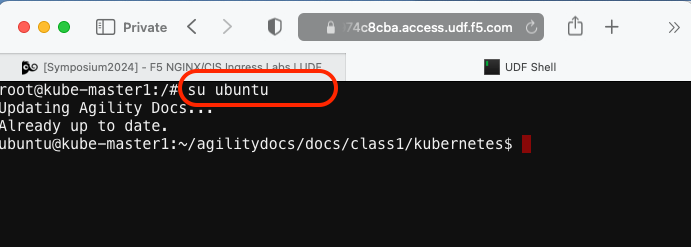
su ubuntuSet the working directy with the “cd” command.
Note
All the files in the working directory are available upon login of the ubuntu user account.
cd ~/agilitydocs/docs/class1/kubernetes
Check the Kubernetes cluster nodes.
You can manage nodes in your instance using the CLI. The CLI interacts with node objects that are representations of actual node hosts. The master uses the information from node objects to validate nodes with health checks.
To list all nodes that are known to the master:

kubectl get nodes
Attention
If the node STATUS shows NotReady or SchedulingDisabled contact the lab proctor. The node is not passing the health checks performed from the master, therefore pods cannot be scheduled for placement on the node.
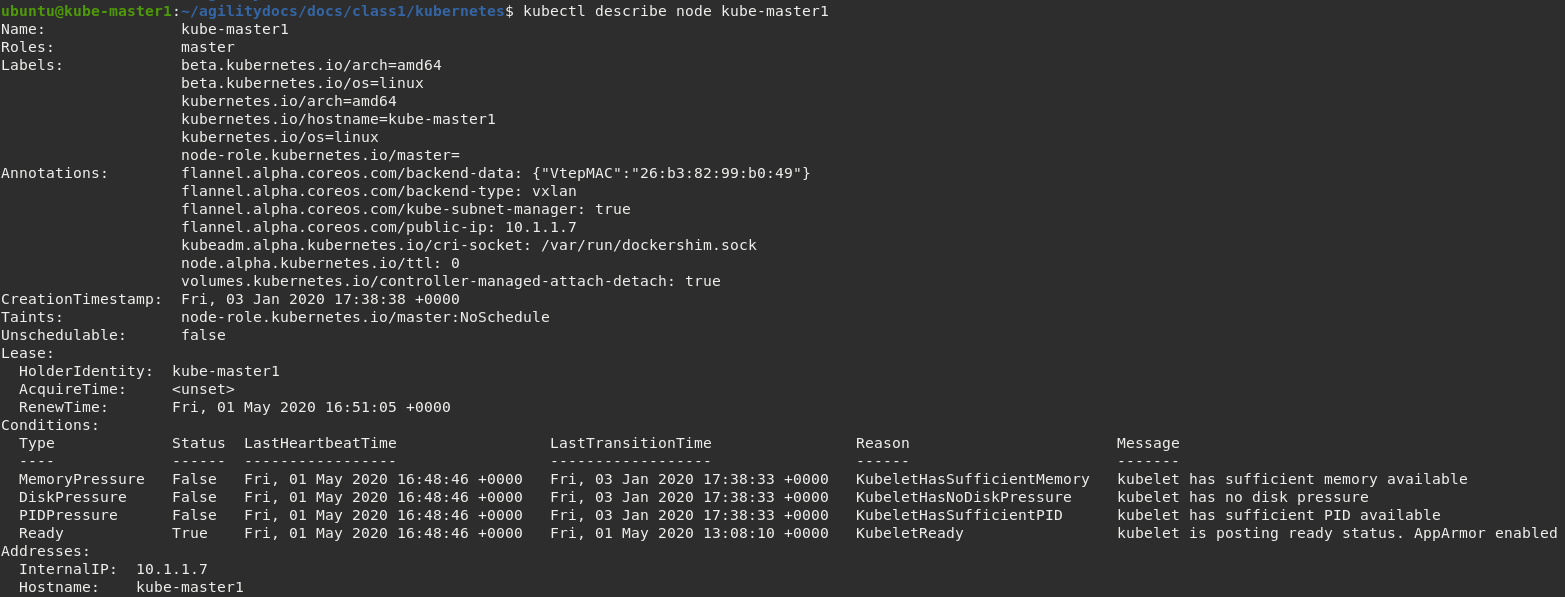
To get more detailed information about a specific node, including the reason for the current condition use the kubectl describe node command. This does provide alot of very useful information and can assist with throubleshooting issues.
kubectl describe node kube-master1
CIS Deployment
See also
For a more thorough explanation of all the settings and options see F5 Container Ingress Services - Kubernetes
Now that BIG-IP is licensed and prepped with the “kubernetes” partition, we need to define a Kubernetes deployment and create a Kubernetes secret to hide our bigip credentials.
Create bigip login secret
kubectl create secret generic bigip-login -n kube-system --from-literal=username=admin --from-literal=password=F5site02@
You should see something similar to this:

Create kubernetes service account for bigip controller
kubectl create serviceaccount k8s-bigip-ctlr -n kube-system
You should see something similar to this:

Create cluster role for bigip service account (admin rights, but can be modified for your environment)
kubectl create clusterrolebinding k8s-bigip-ctlr-clusteradmin --clusterrole=cluster-admin --serviceaccount=kube-system:k8s-bigip-ctlr
You should see something similar to this:

At this point we have two deployment mode options, Nodeport or ClusterIP. This class will feature both modes. For more information see BIG-IP Controller Modes
Lets start with Nodeport mode
Note
- For your convenience the file can be found in /home/ubuntu/agilitydocs/docs/class1/kubernetes (downloaded earlier in the clone git repo step).
- Or you can copy and paste the file below and create your own file.
- If you have issues with your yaml and syntax (indentation MATTERS), you can try to use an online parser to help you : Yaml parser
nodeport-deployment.yaml¶1apiVersion: apps/v1 2kind: Deployment 3metadata: 4 name: k8s-bigip-ctlr-deployment 5 namespace: kube-system 6spec: 7 replicas: 1 8 selector: 9 matchLabels: 10 app: k8s-bigip-ctlr 11 strategy: 12 type: RollingUpdate 13 template: 14 metadata: 15 labels: 16 app: k8s-bigip-ctlr 17 name: k8s-bigip-ctlr 18 spec: 19 serviceAccountName: k8s-bigip-ctlr 20 containers: 21 - args: 22 - --bigip-username=$(BIGIP_USERNAME) 23 - --bigip-password=$(BIGIP_PASSWORD) 24 - --bigip-url=10.1.1.4 25 - --bigip-partition=kubernetes 26 - --pool-member-type=nodeport 27 - --insecure=true 28 - --agent=as3 29 - --log-level=info 30 - --custom-resource-mode=false 31 - --log-as3-response=true 32 - --as3-validation=true 33 command: 34 - /app/bin/k8s-bigip-ctlr 35 env: 36 - name: BIGIP_USERNAME 37 valueFrom: 38 secretKeyRef: 39 key: username 40 name: bigip-login 41 - name: BIGIP_PASSWORD 42 valueFrom: 43 secretKeyRef: 44 key: password 45 name: bigip-login 46 image: f5networks/k8s-bigip-ctlr:latest 47 imagePullPolicy: IfNotPresent 48 name: k8s-bigip-ctlr 49 dnsPolicy: ClusterFirst 50 #imagePullSecrets: 51 # - name: f5-docker-images
Once you have your yaml file setup, you can try to launch your deployment. It will start our f5-k8s-controller container on one of our nodes.
Note
This may take around 30sec to be in a running state.
kubectl create -f nodeport-deployment.yaml
Verify the deployment “deployed”
kubectl get deployment k8s-bigip-ctlr --namespace kube-system

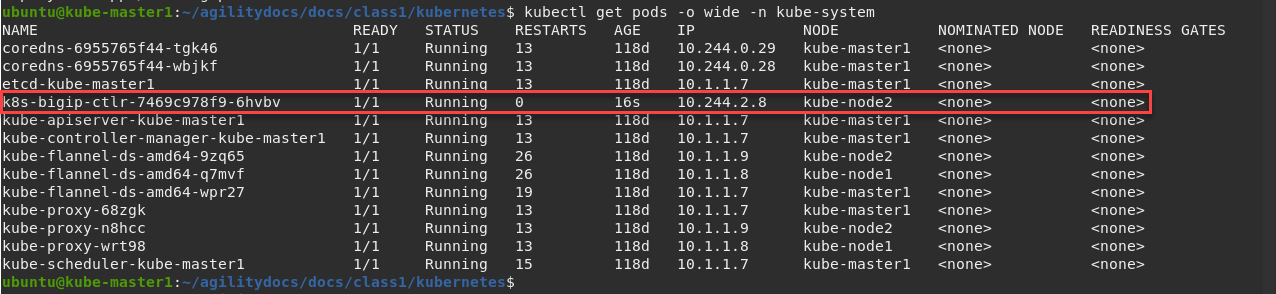
To locate on which node the CIS service is running, you can use the following command:
kubectl get pods -o wide -n kube-system
We can see that our container is running on kube-node2 below.
Troubleshooting
If you need to troubleshoot your container, you have two different ways to check the logs, kubectl command or docker command.
Attention
Depending on your deployment, CIS can be running on either kube-node1 or kube-node2. In our example above it’s running on kube-node2
Using
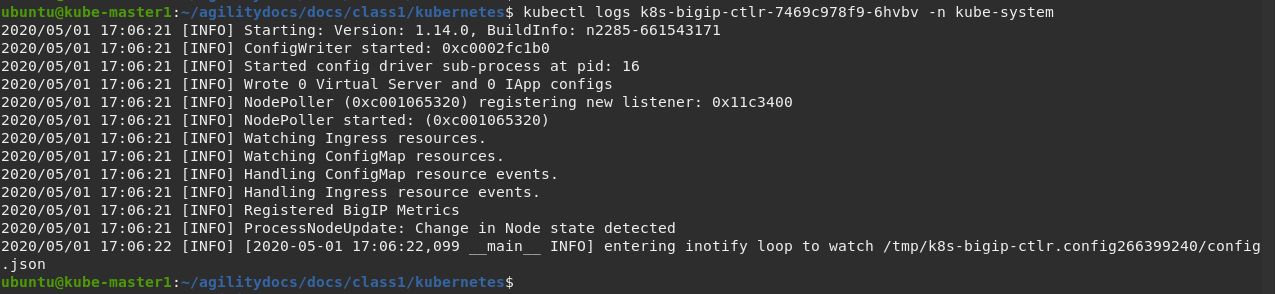
kubectlcommand: you need to use the full name of your pod as shown in the previous image.# For example:
kubectl logs k8s-bigip-ctlr-7469c978f9-6hvbv -n kube-system